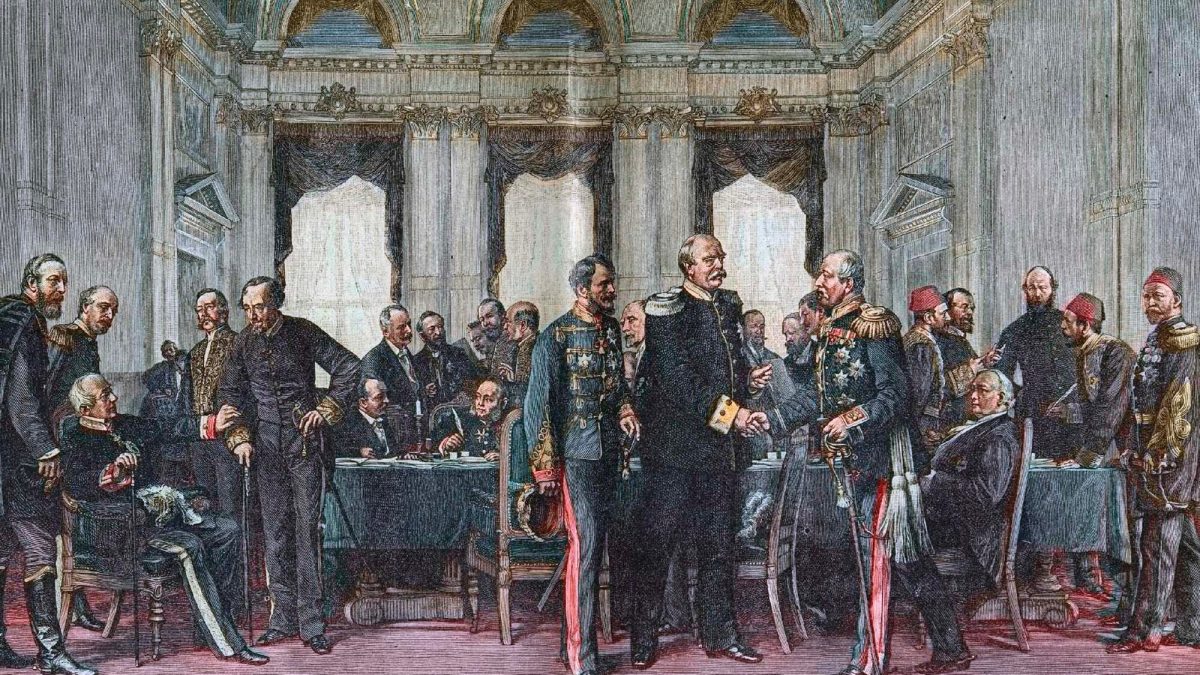
The Berlin Conference of 1884 to 1885 was a meeting of colonial powers that concluded with the signing of the General Act of Berlin, an agreement regulating European colonisation and trade in Africa during the period of New Imperialism. The conference of fourteen countries was organised by Otto von Bismarck, the first chancellor of Germany, at the request of Leopold II of Belgium, at a building on Berlin's central Wilhelmstrasse. It met on 15 November 1884 and, after an adjournment, concluded on 26 February 1885 with the signing of the General Act.
What Was Agreed
During the conference the delegates also discussed other related issues and agreed on a common framework for the recognition of European "effective occupation" of African coastal territory elsewhere on the continent. After the conference, European claims to African territory increased with international legal recognition, since there was now a legal framework for establishing colonies. The General Act can be seen as formalising the ongoing Scramble for Africa, and the conference contributed to ushering in a period of heightened colonial activity by the European powers. It is sometimes cited as being responsible for the "carve-up of Africa".
A Debated Legacy
Some scholars warn against overstating the conference's role in the colonial partitioning of Africa, and draw attention to the many bilateral agreements concluded before and after it. A 2024 study found that the only borders set at the conference were those of the Congo region, which were subsequently revised, and that most of Africa's borders did not take their final form until more than two decades later. The American historians Wm. Roger Louis and Prosser Gifford conceded, however, that "the Berlin Act did have a relevance to the course of the partition" of Africa.
Economic Motives
European powers were also driven by economic motivations, since competition for the vast natural resources of the continent was crucial for industrialisation and expansion. As European industries grew, raw materials such as rubber, minerals, ivory and cotton made Africa highly valuable, and control over its markets enabled European powers to sell manufactured goods, reinforcing their economic dominance in both resources and trade. The conference recognised territorial claims in resource-rich areas and set out regulations to reduce conflict among competing colonial powers. Economic rivalries, particularly between Britain and France, heightened the urgency to secure colonies before monopolies could be established in strategic regions such as the Congo Basin, and the industrial surplus in Europe further encouraged expansion.
Who Gained
Six of the fourteen countries represented, Austria-Hungary, Russia, Denmark, the Netherlands, Sweden-Norway and the United States, went home without having secured any zones of interest in Africa.
Before Berlin
Before the conference European diplomats had already begun to interact with African rulers and to establish connections to continental trade networks. In the early nineteenth century European demand for ivory, which was often used in the production of luxury goods, led many European merchants into the interior markets of Africa, but European spheres of power and influence were still limited to coastal Africa, where Europeans had only trading posts protected by gunboats. In 1876 King Leopold II of Belgium, who had founded and controlled the International African Association that year, invited Henry Morton Stanley to join him in researching and "civilising" the continent. In 1878 the International Congo Society was also formed, with more economic goals but still closely related to the former society, and Leopold secretly bought off the foreign investors in the Congo Society, which was turned to imperialist ends, while the African Society served mainly as a philanthropic front.
Explorers and Missionaries
Explorers and missionaries played a significant role in laying the groundwork for the conference. They mapped large parts of the continent, negotiated treaties with local leaders and promoted narratives that justified European expansion. Stanley, in particular, conducted expeditions into the Congo Basin on behalf of Leopold II, securing treaties that later enabled Belgium to claim sovereignty over the region, and missionaries advanced European influence by seeking to spread Christianity and Western culture.
Who Was in the Room
The European race for colonies had made Germany launch expeditions of its own, which frightened British and French statesmen. Hoping to soothe the brewing conflict, Leopold II convinced France and Germany that common trade in Africa was in the best interests of all three countries, and with British support and Portuguese initiative Bismarck called together representatives of 13 European nations and the United States. No African countries were invited. Sultan Barghash bin Said of Zanzibar asked to send a representative, the only African head of state to do so, but the request was rejected under pressure from the Anti-Slavery Reporter, a British organisation that objected to Zanzibar's role in the slave trade. Each of the 14 countries had a single vote on formal resolutions, regardless of the number of its delegates or its presence in the region, and the United States uniquely reserved the right to accept or decline the conclusions of the conference.
The General Act and the Congo
One of the major outcomes of the General Act was that the properties occupied by Leopold's International Congo Society were confirmed as belonging to the Society. On 1 August 1885, just months after the conference closed, Leopold's representative in the Congo announced that the territory would be called the "Congo Free State", a name that was not in use at the time of the conference and does not appear in the General Act. The Belgian official gazette later stated that from that date Leopold II was to be considered the sovereign of the new state, even though that determination was not made at the Berlin Conference.
Why It Matters
The Berlin Conference became a symbol of how Africa's future was decided without the participation of African rulers. Whether or not it drew the borders itself, it set the rules under which the partition proceeded, and the colonial boundaries that followed have shaped African politics, economies and conflicts since independence. For that reason it is a central event in the history of colonialism, and it remains a reference point in debates about the legacy of empire.