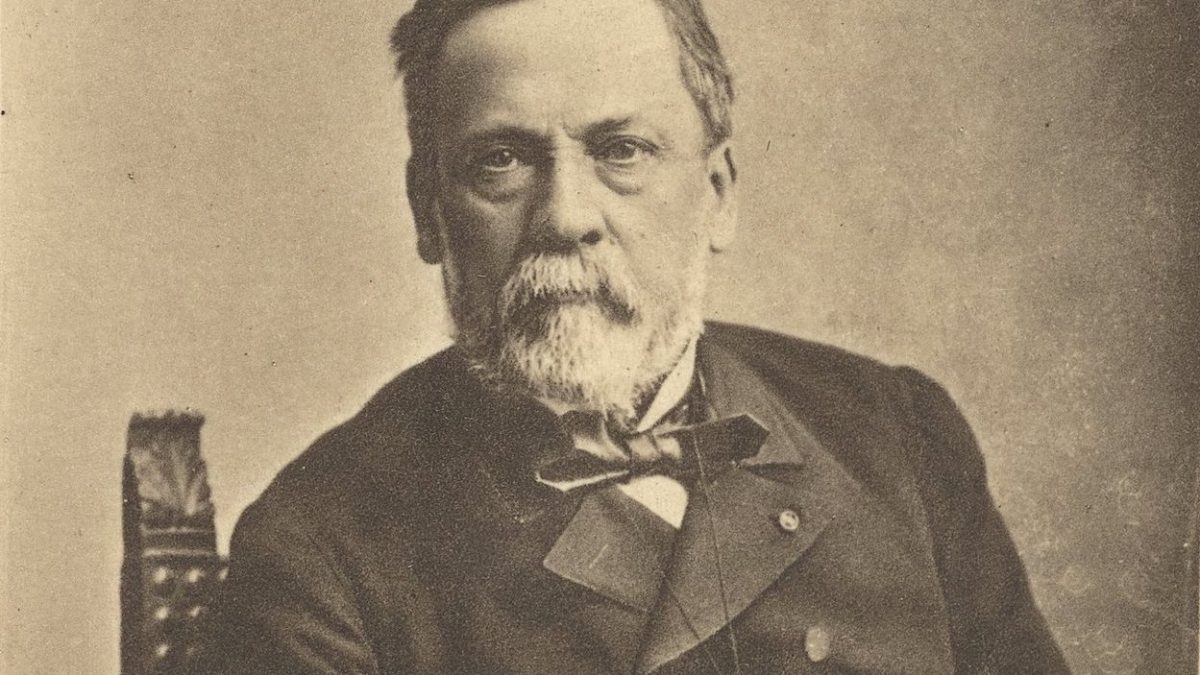
Louis Pasteur (27 December 1822 to 28 September 1895) was a French chemist, pharmacist and microbiologist renowned for his discoveries of the principles of vaccination, microbial fermentation and pasteurization, the last of which is named after him. His research broke new ground in understanding the causes and prevention of disease and laid down the foundations of hygiene, public health and much of modern medicine. His work is credited with saving millions of lives through the development of vaccines for rabies and anthrax, and he is regarded as one of the founders of modern bacteriology. This biography follows his life, his discoveries and his legacy.
Louis Pasteur at a Glance
| Full name | Louis Pasteur |
| Born | 27 December 1822, Dole, Jura, France |
| Died | 28 September 1895, near Paris (aged 72) |
| Profession | Chemist, pharmacist and microbiologist |
| Known for | Vaccination principles, pasteurization, germ theory, rabies vaccine |
| Wife | Marie Laurent (married 29 May 1849) |
| Children | Five, of whom two survived to adulthood: Jean Baptiste and Marie Louise |
| Institution | Founder and director of the Pasteur Institute (inaugurated 1888) |
Early Life in Dole and Arbois
Louis Pasteur was born on 27 December 1822 in Dole, in the Jura region of France, into a Catholic family of a poor tanner. He was the third child of Jean-Joseph Pasteur and Jeanne-Etiennette Roqui. The family moved to Marnoz in 1826 and then to Arbois in 1827, and Pasteur entered primary school in 1831. He was dyslexic and dysgraphic, and in his early years he was an average student who was not particularly academic. His interests were fishing and sketching, and he drew many pastels and portraits of his parents, friends and neighbours.
He attended secondary school at the Collège d'Arbois. In October 1838 he left for Paris to enrol in a boarding school but became homesick and returned home in November. In 1839 he entered the Collège Royal at Besançon to study philosophy and earned his Bachelor of Letters degree in 1840. He then continued a science course with special mathematics, failed his first examination in 1841, and eventually passed his general science degree at Dijon in 1842, although his grade in chemistry was only mediocre. It was not an obvious start for a man who would transform medicine.
Education and Early Career
In 1842 Pasteur took the entrance test for the École Normale Supérieure. He passed the first set of tests, but because his ranking was low he decided to try again the following year. He prepared at a Parisian boarding school, attended classes at the Lycée Saint-Louis and lectures by Jean-Baptiste Dumas at the Sorbonne, and in 1843 passed with a high ranking. He received his licence in sciences in 1845, and in 1847 submitted two theses, one in chemistry and one in physics. After serving briefly as professor of physics at the Dijon Lycée in 1848, he became professor of chemistry at the University of Strasbourg, where he met Marie Laurent, the daughter of the university's rector. They married on 29 May 1849.
In 1854 he was named dean of the new faculty of sciences at the University of Lille, where he began his studies on fermentation. It was there that he made a remark that has become famous: "in the field of observation, chance favours only the prepared mind." In 1857 he moved to Paris as director of scientific studies at the École Normale Supérieure, where he introduced reforms that raised academic standards, although some of his strict decrees led to two serious student revolts. In 1867 he became chair of organic chemistry at the Sorbonne and set up the École Normale's laboratory of physiological chemistry, which he directed until 1888.
Molecular Asymmetry
Pasteur's early work as a chemist concerned the tartrates, a group of compounds he examined for their chemical, optical and crystallographic properties. In 1848 he resolved a puzzle about tartaric acid. A solution of the acid derived from living things rotated the plane of polarised light, while tartaric acid made by chemical synthesis did not, even though its chemical reactions and composition were identical. Pasteur noticed that in racemic mixtures of tartrates, half of the crystals were right-handed and half were left-handed, and he determined that the optical activity was related to the shape of the crystals and to an asymmetric arrangement of the molecules. It was the first time anyone had demonstrated molecular chirality and the first explanation of isomerism. Some historians consider it his most profound and original contribution to science.
Fermentation, Pasteurization and Germ Theory
In 1856 a local wine manufacturer whose son was one of Pasteur's students sought his advice about problems with making beetroot alcohol and with souring. Pasteur began researching fermentation, confirming that yeast was alive and demonstrating that yeast was responsible for turning sugar into alcohol. He also showed that when a different microorganism contaminated the wine, lactic acid was produced and the wine turned sour. In 1861 he observed that less sugar fermented per part of yeast when the yeast was exposed to air, which became known as the Pasteur effect.
These findings led to the technique for which the public knows him best: treating milk and wine to stop bacterial contamination, a process now called pasteurization. His experiments also helped to disprove the doctrine of spontaneous generation. Under the auspices of the French Academy of Sciences, he demonstrated that in sterilised and sealed flasks nothing ever developed, while in sterilised but open flasks microorganisms could grow. The academy awarded him the Alhumbert Prize, carrying 2,500 francs, in 1862. Taken together, his experiments supported the germ theory of disease, which was still a minor medical idea at the time, by showing that diseases could be prevented by killing or stopping germs.
Vaccines for Anthrax and Rabies
Pasteur then turned to vaccines. He introduced the term "attenuation" for the weakening of a germ's virulence, and he gave artificially weakened disease organisms the generic name of vaccines, in honour of Edward Jenner's earlier discovery with cowpox and smallpox. His laboratory worked on anthrax, a disease that killed cattle. After the bacterium had been identified by Robert Koch, Pasteur's team found that growing anthrax bacilli at about 42 degrees Celsius made them unable to produce spores, and he described the method to the French Academy of Sciences on 28 February 1881. He also told farmers not to bury dead animals in the fields after finding anthrax bacteria in earthworm excrement.
His best-known success came with rabies. His laboratory produced the first rabies vaccine using a method developed by his assistant Emile Roux, which involved growing the virus in rabbits and weakening it by drying the affected nerve tissue. Pasteur wrote that it had been tested in 50 dogs before its first human trial. On 6 July 1885 it was used on nine-year-old Joseph Meister, who had been badly mauled by a rabid dog. Over 11 days the boy received 13 inoculations, each using virus that had been weakened for a shorter time. The decision carried personal risk for Pasteur, because he was not a licensed physician and could have faced prosecution for treating the boy.
The Pasteur Institute
After the rabies vaccine, Pasteur proposed an institute to produce and study it. Fundraising began in 1887 with donations from many countries, and the institute was inaugurated on 14 November 1888. Its purposes were the treatment of rabies and the study of virulent and contagious diseases. Pasteur brought together scientists from various specialities, and the first five departments were led by Émile Duclaux, Charles Chamberland, Élie Metchnikoff, Jacques-Joseph Grancher and Émile Roux. He remained director of the Pasteur Institute until his death, and its research has continued to the present day under his name.
Controversies
Pasteur's reputation is not without controversy. A historical reassessment of his notebooks revealed that he practised deception to overcome his rivals. His relationship with the German bacteriologist Robert Koch was bitter: Koch criticised Pasteur's anthrax work in the early 1880s, accused him of using impure cultures and of keeping his methods secret, and Pasteur replied in kind. Later scholarship has also looked at his experimental ethics. These criticisms do not remove his achievements, but they show that his scientific career involved competition, rivalry and imperfection as well as genius.
Family and Personal Life
Pasteur married Marie Pasteur, née Laurent, in 1849, and she acted as his scientific assistant. They had five children, three of whom died young. Their eldest daughter, Jeanne, died of typhoid fever aged nine in 1859, and two-year-old Camille died of a liver tumour in 1865. Cécile also died of typhoid fever, on 23 May 1866 at the age of 12. Only Jean Baptiste, born in 1851, and Marie Louise, born in 1858, survived to adulthood, and Jean Baptiste served as a soldier in the Franco-Prussian War. Historians note that these losses to infectious disease shaped the personal urgency of his research.
In 1868 Pasteur suffered a severe stroke that paralysed the left side of his body, from which he recovered. His grandson wrote that he kept only a spiritualism without religious practice, although many Catholic observers said he remained an ardent Christian. He is quoted as saying that he prayed while he worked in the laboratory.
Honours and Death
Pasteur's honours were numerous. The Royal Society of London gave him the Rumford Medal in 1856 and the Copley Medal in 1874, and he was elected a Foreign Member of the Royal Society in 1869. He was elected to the Académie française in 1881 and received the Albert Medal of the Royal Society of Arts in 1882. He was made a Chevalier of the Legion of Honour in 1853 and a Grand Cross in 1881.
A stroke or uraemia in 1894 severely impaired his health, and he died on 28 September 1895 near Paris. He was given a state funeral and initially buried at Notre-Dame, but his remains were reinterred at the Pasteur Institute in a vault decorated with Byzantine mosaics depicting his accomplishments.
Legacy
Streets, schools and hospitals around the world bear his name, and the Institut Pasteur and the Université Louis Pasteur were both named after him. UNESCO and the Institut Pasteur jointly created a medal on the centenary of his death, given every two years for outstanding research contributing to a beneficial impact on human health. The French academician Henri Mondor said that Pasteur was neither a physician nor a surgeon, but that no one has done as much for medicine and surgery as he has. Every glass of pasteurised milk and every vaccination programme continues his work.