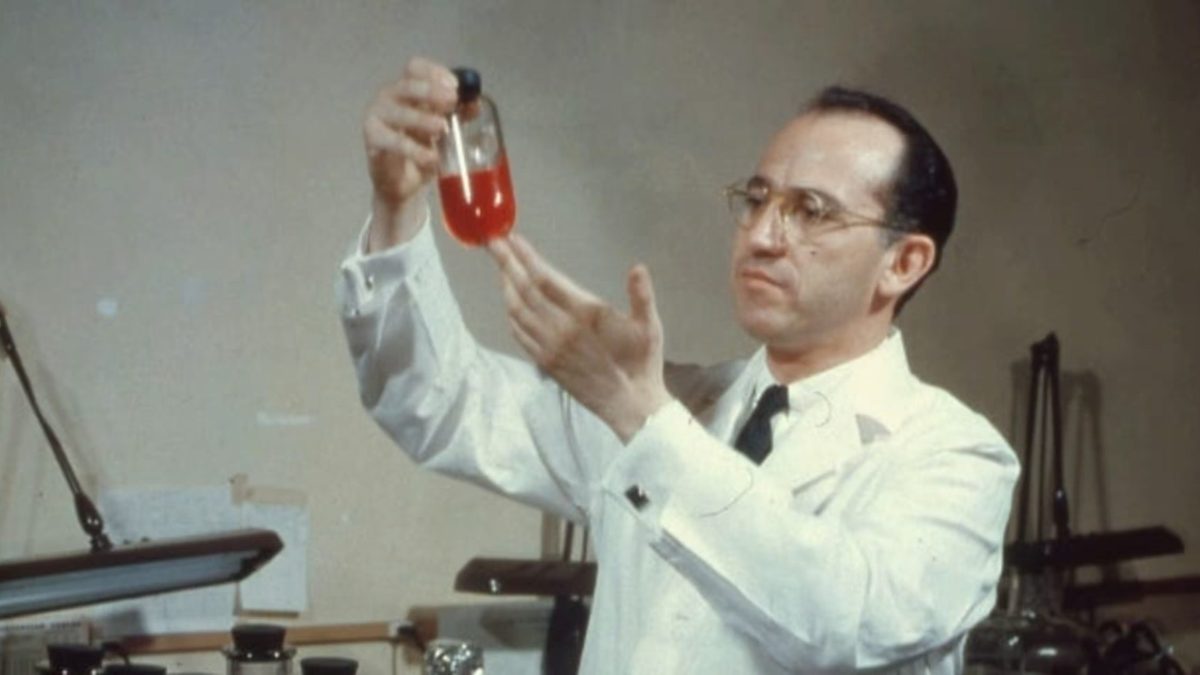
Jonas Salk (28 October 1914 to 23 June 1995) was an American virologist and medical researcher who developed one of the first successful polio vaccines. When the success of the vaccine was announced in April 1955, he was hailed as a miracle worker, and he chose not to patent the vaccine or seek any profit from it in order to maximise its global distribution. He later founded the Salk Institute for Biological Studies in La Jolla, California. This biography follows his life, his research and his legacy.
Jonas Salk at a Glance
| Full name | Jonas Edward Salk |
| Born | 28 October 1914, New York City, United States |
| Died | 23 June 1995, La Jolla, California (aged 80) |
| Profession | Virologist and medical researcher |
| Known for | Inactivated polio vaccine (announced 12 April 1955) |
| Institution founded | Salk Institute for Biological Studies (opened 1963) |
| Education | City College of New York; New York University School of Medicine |
| Wives | Donna Lindsay (married 1939) and Françoise Gilot (married 1970) |
| Children | Peter, Darrell and Jonathan |
Early Life in New York
Jonas Salk was born on 28 October 1914 in New York City to Daniel and Dora Salk. His father was born in New Jersey to Jewish immigrant parents, and his mother was born in Minsk and emigrated to the United States aged 12. His parents did not receive extensive formal education. He had two younger brothers, Herman and Lee, who became a child psychologist, and the family lived in East Harlem and later in the Bronx. At 13 he entered Townsend Harris Hall Prep School, a public school for intellectually gifted students, where he was known as a perfectionist who read everything he could lay his hands on.
Salk entered the City College of New York at the age of 15 and earned a Bachelor of Science degree in chemistry in 1934. At his mother's urging he put aside aspirations of becoming a lawyer and concentrated on the classes needed for medical school. He enrolled at New York University School of Medicine, which, unlike several rival schools, did not apply strict quotas against Jewish students. As a child he had not shown any interest in science, saying later that he was merely interested in the human side of nature.
Choosing Research Over Practice
In medical school Salk stood out because he decided he did not want to practise medicine. He wanted to be of help to humankind in a larger sense than treating patients one by one, and the laboratory gave new direction to his life. In his last year he spent time in a laboratory involved in studies of influenza and tested whether a virus could be killed while still immunising. In 1941 he worked in the laboratory of Thomas Francis at the University of Michigan, and later worked with Francis on an army-commissioned project to develop an influenza vaccine, which became widely used at army bases. Salk isolated one of the influenza strains included in the final vaccine.
The Polio Research
In 1947 Salk accepted a professorship at the University of Pittsburgh School of Medicine. In 1948 Harry Weaver, the director of research at the National Foundation for Infantile Paralysis, asked him to determine whether there were more types of polio than the three then known, and offered additional space, equipment and researchers. Salk began a project that would occupy him for seven years. Extensive publicity and fear of polio led to much increased funding, which reached 67 million dollars by 1955. Despite that, much of the research continued on live vaccines, but Salk decided to use what he believed was the safer killed virus, rather than a weakened form like the one Albert Sabin was developing.
After successful tests on laboratory animals, on 2 July 1952 Salk injected 43 children at the D. T. Watson Home for Crippled Children in Sewickley, Pennsylvania, with his killed-virus vaccine. He vaccinated his own children in 1953. In 1954 the vaccine was tested on about one million children, known as the polio pioneers. The vaccine was announced as safe on 12 April 1955. The project involved 100 million contributors to the March of Dimes and seven million volunteers, and Salk worked incessantly for two and a half years.
No Patent, No Profit
When asked about patenting the vaccine, Salk chose not to seek any profit from it. The National Foundation for Infantile Paralysis and the University of Pittsburgh looked into patenting it after deciding not to profit from it, but concluded that the techniques used were probably not novel enough to patent. An immediate rush to vaccinate began in the United States and around the world. Countries including Canada, Sweden, Denmark, Norway, West Germany, the Netherlands, Switzerland and Belgium began immunisation campaigns using his vaccine, and by 1959 it had reached about 90 countries. Albert Sabin's attenuated oral vaccine came into commercial use in 1961, and less than 25 years after the release of Salk's vaccine, domestic transmission of polio had been eliminated in the United States.
Becoming a Public Figure
Salk's sudden fame was not easy for him. He was celebrated as a hero and was given the highest award for services by the Commonwealth of Pennsylvania in 1955, but the attention affected his privacy and his work. The governor said that as a parent he was humbly thankful to Dr Salk. Salk, for his part, continued to describe himself as a scientist rather than a celebrity, and he campaigned vigorously for mandatory vaccination throughout the rest of his life, calling the universal vaccination of children against disease a moral commitment.
The Salk Institute
In the years after his discovery, supporters, especially the National Foundation, helped him build his dream of a research complex for investigating biological phenomena from the cell to society. The Salk Institute for Biological Studies opened in 1963 in the La Jolla neighbourhood of San Diego, in a building designed by the architect Louis Kahn. Salk believed the institution would help new and upcoming scientists along in their careers, and in 1966 he described his plan for a Socratic academy in which the supposedly alienated cultures of science and humanism would cross-fertilise. The institute remains a leading centre of medical and scientific research.
Later Research
From the mid-1980s Salk turned to research on a vaccine for HIV, and he patented Remune, an immunological therapy. In 1995 he became one of the original signatories of the Ashley Montagu Resolution, which asked the World Court to help end genital mutilation of children. His personal papers are held at the Geisel Library at the University of California, San Diego.
Family and Personal Life
The day after his graduation from medical school in 1939, Salk married Donna Lindsay, a master's candidate at the New York College of Social Work. Her father, a wealthy Manhattan dentist, reportedly viewed Salk as a social inferior, and agreed to the marriage on two conditions: that Salk wait until he could be listed as an official doctor on the wedding invitations, and that he give himself a middle name, which is how he became Jonas Edward Salk. They had three children. Peter became a physician and part-time professor of infectious diseases at the University of Pittsburgh, Darrell worked with vaccines and genetics and retired from the pediatrics faculty at the University of Washington School of Medicine, and Jonathan became a psychiatrist and assistant clinical professor at the David Geffen School of Medicine at UCLA. The couple divorced in 1968, and two years later Salk married the French painter Françoise Gilot, who had formerly been the partner of Pablo Picasso.
Death and Legacy
Jonas Salk died of heart failure on 23 June 1995 in La Jolla, aged 80, and was buried at El Camino Memorial Park in San Diego. His legacy is both medical and moral. His vaccine, and the mass public cooperation that tested it, changed the fear of polio into a story of hope, and his decision not to patent it remains one of the best-known examples of a scientist putting public health ahead of profit. The institute that bears his name continues to train scientists, and the childhood vaccination programmes that followed his work have protected generations.