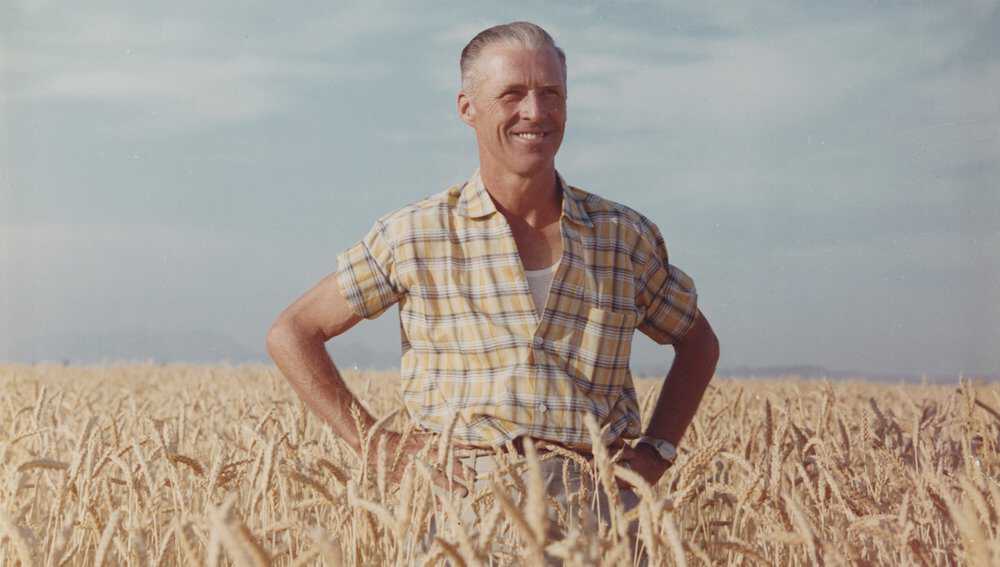
Norman Borlaug (25 March 1914 to 12 September 2009) was an American agronomist who led initiatives worldwide that contributed to the extensive increases in agricultural production termed the Green Revolution. He received the Nobel Peace Prize, the Presidential Medal of Freedom and the Congressional Gold Medal, and is one of only seven people to have received all three. He is often called the father of the Green Revolution and is credited with saving over a billion people worldwide from starvation, although that number is an estimate, not a precise count. This biography follows his life, his work and the debates about his legacy.
Norman Borlaug at a Glance
| Full name | Norman Ernest Borlaug |
| Born | 25 March 1914, Saude, near Cresco, Iowa, United States |
| Died | 12 September 2009 (aged 95) |
| Profession | Agronomist, plant pathologist and geneticist |
| Known for | Semi-dwarf, disease-resistant wheat and the Green Revolution |
| Nobel Prize | Peace, 1970 |
| Education | University of Minnesota (BS forestry 1937; PhD 1942) |
| Wife | Margaret Gibson (married 1937) |
| Children | Norma Jean, Scotty and William |
Early Life in Iowa
Norman Borlaug was the great-grandchild of Norwegian immigrants to the United States. He was born on 25 March 1914 on his grandparents' farm in Saude, near Cresco, Iowa, the first of four children of Henry and Clara Borlaug. From the age of seven to 19 he worked on the 106-acre family farm, and he attended a one-room rural school through eighth grade. He attributed his decision to leave the farm and pursue education to his grandfather's urgent encouragement. "You're wiser to fill your head now if you want to fill your belly later on," Nels Borlaug told him.
When he applied to the University of Minnesota in 1933, Borlaug failed its entrance exam, but he was accepted into the newly created two-year General College. After two quarters he transferred to the College of Agriculture's forestry programme. He was a member of the men's wrestling team and reached the Big Ten semifinals, and he later promoted the sport and was inducted into the National Wrestling Hall of Fame. He earned a Bachelor of Science in forestry in 1937 and, after attending a lecture on plant diseases by the plant pathologist Elvin Charles Stakman, decided to study plant pathology. He received his PhD in plant pathology and genetics in 1942. While in college he met a co-worker, Margaret Gibson, at a coffee shop where he waited tables, and they married in 1937.
From DuPont to Mexico
From 1942 to 1944 Borlaug worked as a microbiologist at DuPont in Delaware. After Pearl Harbor he tried to enlist but was refused under wartime labour regulations, because his laboratory was assigned to research for the armed forces. In July 1944, after rejecting DuPont's offer to double his salary, he flew to Mexico City to head the new Cooperative Wheat Research and Production Program, a joint venture between the Rockefeller Foundation and the Mexican government. He left behind, temporarily, his pregnant wife and 14-month-old daughter.
The first years were difficult. He lacked trained scientists and equipment, and local farmers were hostile because of serious crop losses from stem rust between 1939 and 1941. He later wrote that it often appeared he had made a dreadful mistake. He spent his first ten years breeding wheat varieties resistant to disease, including rust, and his group made 6,000 individual wheat crossings. He also realised that he could speed up breeding by using Mexico's two growing seasons, breeding in the central highlands in the summer and taking seeds north to a research station in Sonora. His supervisor opposed the plan, and Borlaug resigned, but Stakman calmed the dispute and the double season went ahead from 1945. An unexpected benefit was that the new varieties could adapt to a wide range of conditions.
Semi-Dwarf Wheat
Tall, thin wheat tended to collapse under the weight of extra grain when fertilised, a problem called lodging. In 1953 Borlaug acquired a Japanese dwarf wheat variety called Norin 10 and bred it with his own lines to produce shorter, stronger stalks. His new semi-dwarf, disease-resistant varieties dramatically changed the potential yield of spring wheat. By 1963, 95 percent of Mexico's wheat crops used the semi-dwarf varieties, and the harvest that year was six times larger than in 1944, the year he arrived. Mexico had become fully self-sufficient in wheat and a net exporter.
The Green Revolution in South Asia
In 1963 the Rockefeller Foundation and the Mexican government sent Borlaug to India to continue his work, and he supplied 100 kilograms of seed from each of four promising strains to the Indian Agricultural Research Institute. During the mid-1960s the Indian subcontinent was at war and experienced minor famine, and bureaucracy and cultural opposition initially prevented Borlaug from planting the new strains immediately. The biologist Paul Ehrlich wrote in 1968 that the battle to feed humanity was over and that hundreds of millions would starve in the 1970s and 1980s. In fact, in Pakistan wheat yields nearly doubled from 4.6 million tons in 1965 to 7.3 million tons in 1970, and Pakistan was self-sufficient in wheat by 1968. In India they rose from 12.3 million tons in 1965 to 20.1 million tons in 1970, and by 1974 India was self-sufficient in all cereals. Food production in both nations has increased faster than the rate of population growth since the 1960s.
Nobel Peace Prize
For his contributions to the world food supply, Borlaug was awarded the Nobel Peace Prize in 1970. Norwegian officials notified his wife in Mexico City at four in the morning, but he had already left for the test fields, and when she told him, he reportedly thought it was a hoax. In his Nobel lecture he said the committee was selecting an individual to symbolise the vital role of agriculture in a world hungry both for bread and for peace. He added that the Green Revolution had won only a temporary success in the war against hunger and had given humanity a breathing space, and he warned about the population explosion.
Africa, the World Food Prize and Later Work
Borlaug officially retired from his CIMMYT position in 1979 but remained a senior consultant, and from 1984 he taught at Texas A&M University, where he was a distinguished professor of international agriculture until his death. In 1984, during the Ethiopian famine, he was persuaded by Ryoichi Sasakawa to help bring his methods to Africa, and he became president of the Sasakawa Africa Association from 1986 to 2009. More than eight million small-scale farmers in 15 African countries have since been trained in its methods, which have helped many double or triple grain production. In 1986 he created the World Food Prize to recognise advances in the quality, quantity or availability of food, and in 2005 he helped convene the panel that led to the Borlaug Global Rust Initiative, which responds to the Ug99 stem rust threat.
Criticism
Borlaug's work has attracted serious criticism. Critics argue that the Green Revolution brought long-term effects including debt, social inequality and the displacement of peasant farmers, that it benefitted agribusiness and agrochemical corporations, and that heavy use of fertiliser and pesticides, along with the reduced diversity of crops, harmed the environment. Borlaug, who also defended pesticides and agricultural biotechnology, answered that some environmental lobbyists had never experienced the physical sensation of hunger. He conceded that his work had been a change in the right direction but had not transformed the world into a utopia. He also argued that raising yields on the best farmland reduces the pressure to clear forests, an idea known as the Borlaug hypothesis.
Family and Death
Borlaug and Margaret Gibson had three children: Norma Jean, known as Jeanie, Scotty, who died of spina bifida soon after birth, and William. Margaret died on 8 March 2007 aged 95, after 69 years of marriage. Borlaug died on 12 September 2009, aged 95. His legacy is a world in which hundreds of millions of people have more food than earlier forecasts allowed, together with a continuing debate about how to feed a growing population without damaging the planet.