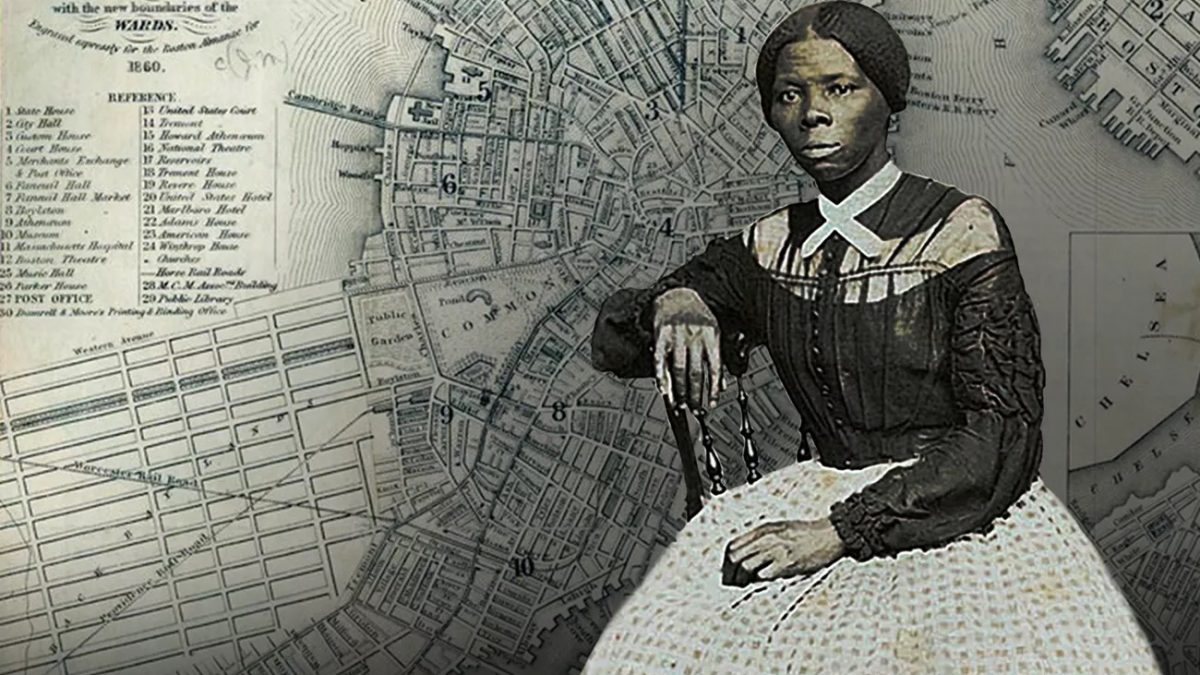
Harriet Tubman (born Araminta Ross, c. March 1822 to 10 March 1913) was an American abolitionist and social activist. After escaping slavery, she made some 13 missions to rescue approximately 70 enslaved people, including her family and friends, using the network of antislavery activists and safe houses known as the Underground Railroad. During the American Civil War she served as an armed scout and spy for the Union Army, and in her later years she was an activist for women's suffrage. This biography follows her life, her missions and her legacy.
Harriet Tubman at a Glance
| Full name | Harriet Tubman, born Araminta "Minty" Ross |
| Born | c. March 1822, Dorchester County, Maryland, United States |
| Died | 10 March 1913, Auburn, New York |
| Profession | Abolitionist, Union Army scout and spy, social activist |
| Known for | About 13 rescue missions on the Underground Railroad; Combahee River Raid |
| Nickname | "Moses" |
| Parents | Harriet "Rit" Green and Ben Ross |
| Husbands | John Tubman (c. 1844) and Nelson Davis |
| Home | Farm in Auburn, New York, bought in 1859 |
Birth and Childhood
Tubman was born Araminta "Minty" Ross to enslaved parents, Harriet "Rit" Green and Ben Ross, in Dorchester County, Maryland. As with many enslaved people, the exact year and place of her birth are not known. She reported 1825, her death certificate says 1815 and her gravestone says 1820, but the historian Kate Larson, based on a midwife payment and other documents, concluded that she was born in March 1822. Her mother was a cook for the Brodess family, and her father was a skilled woodsman who managed the timber work on a plantation. Her mother struggled to keep the family together as slavery threatened to tear it apart, and three of her sisters were sold and separated from the family for ever.
As a child, Tubman cared for younger siblings, and at five or six was hired out as a nursemaid, where she was whipped when the baby cried. She recounted later that she was lashed five times before breakfast on one day. As an adolescent she suffered a severe head injury when an overseer threw a two-pound metal weight at an enslaved man who had left work without permission, and it struck her instead. She said it broke her skull. The injury caused headaches, seizures, and spells of unconsciousness for the rest of her life. She also began to have visions and vivid dreams, which she interpreted as revelations from God, and she acquired a passionate faith that guided her actions.
Marriage and Escape
Around 1844 she married John Tubman, a free Black man, and soon afterwards changed her name from Araminta to Harriet, taking her mother's name. In 1849 she became ill, which reduced her value to slave traders, and her enslaver Edward Brodess died. His widow began working to sell the people enslaved by the family. Tubman decided not to wait. She later said that there were two things she had a right to, liberty or death, and that if she could not have one she would have the other.
She escaped with her brothers Ben and Henry on 17 September 1849. Sometime in October or November she escaped again, alone. She used the Underground Railroad, an informal network of free and enslaved Black people, white abolitionists and others. She travelled by night, guided by the North Star, and avoided slave catchers who wanted rewards. On crossing into Pennsylvania, she recalled that she looked at her hands to see if she was the same person, and that there was such glory over everything.
The Underground Railroad
Tubman soon thought of her family, and after Congress passed the Fugitive Slave Act of 1850, which forced officials to help capture escaped people even in free states, she began returning to Maryland to guide others north, eventually to British North America, now Canada. In December 1850 she helped rescue her niece Kessiah and Kessiah's children. From 1851 to 1862 she returned repeatedly to the Eastern Shore of Maryland, rescuing some 70 enslaved people in about 13 expeditions, including her brothers Henry, Ben and Robert, their wives and some of their children. She also gave instructions to 50 to 60 more people who escaped on their own. Because of this work she was nicknamed "Moses", after the biblical figure who led the Hebrews out of Egypt.
Her work required ingenuity. She usually worked during winter, when the long nights and cold weather minimised the chance of being seen, and she started escapes on Saturday evenings, because newspapers would not print runaway notices until Monday morning. Once she disguised herself with a bonnet and carried two live chickens to look as though she was running errands. She used spirituals as coded messages, and she carried a revolver as protection from slave catchers and their dogs. Years later she told an audience: "I never ran my train off the track and I never lost a passenger." The popular legend of a 40,000 dollar reward for her capture is not supported, because the figure was a later invention.
John Brown and Harpers Ferry
In April 1858 Tubman was introduced to the abolitionist John Brown, who advocated violence to destroy slavery. He called her "General Tubman", and her knowledge of support networks in Pennsylvania, Maryland and Delaware was valuable to him. She helped with fundraising and planning, but when the raid on Harpers Ferry took place on 16 October 1859 she was in New York City, having been ill. After Brown was hanged on 2 December, she said that he had done more in dying than a hundred men would in living.
Auburn and the Civil War
In early 1859 Frances Adeline Seward, wife of the abolitionist senator William H. Seward, sold Tubman a seven-acre farm near Auburn, New York, for 1,200 dollars. There she settled her parents and took in relatives and boarders. Her last rescue mission was in November 1860. When the Civil War began she worked for the Union Army, first as a cook and nurse and then as an armed scout and spy. Her intelligence gathering was important in the raid at Combahee Ferry, in which she guided three steamboats with Black soldiers past mines on the Combahee River. The raid liberated more than 700 enslaved people, and she is widely credited as the first woman to lead an armed military operation in the United States. For over three years of service she received a total of only 200 dollars.
Later Life and Suffrage
Tubman later married Nelson Davis, who died of tuberculosis on 14 October 1888. In 1895 she was granted a widow's pension of eight dollars a month, and in 1899 Congress approved a compromise soldier's pension of 20 dollars a month, after some members objected to a woman receiving a full soldier's pension. She became active in the women's suffrage movement. When a white woman asked whether women ought to have the vote, she replied: "I suffered enough to believe it." She attended meetings of suffragist organisations and worked with women such as Susan B. Anthony and Emily Howland. In the 1890s she worked to create the Harriet Tubman Home for the Aged to care for poor Black people, and in 1896 she bid 1,215 dollars at auction for land for it.
Death and Legacy
By 1911 Tubman was so frail that she was admitted to the rest home named in her honour, and a New York newspaper described her as ill and penniless, which prompted new donations. She died of pneumonia on 10 March 1913, surrounded by friends and family. Widely known and respected in her lifetime, she became an American icon after her death and inspired generations of African Americans struggling for equality. In 1978 she became the first African-American woman honoured on a United States postage stamp. Tubman's story endures because of its combination of private courage and public purpose: she freed herself, and then repeatedly returned to free others.