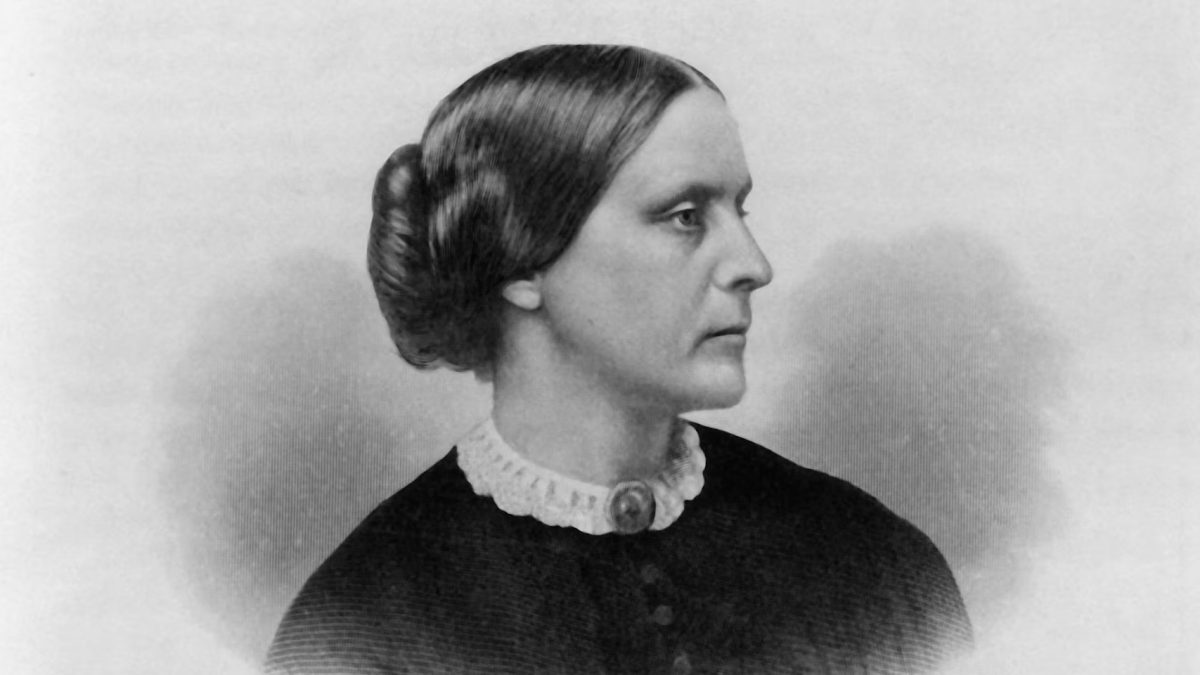
Susan B. Anthony (15 February 1820 to 13 March 1906) was an American social reformer and women's rights activist who played a pivotal role in the women's suffrage movement. Born into a Quaker family committed to social equality, she collected antislavery petitions at the age of 17. In 1851 she met Elizabeth Cady Stanton, who became her lifelong friend and co-worker, and in 1872 she was arrested for voting. This biography follows her life, her campaigns and her legacy.
Susan B. Anthony at a Glance
| Full name | Susan Brownell Anthony |
| Born | 15 February 1820, Adams, Massachusetts, United States |
| Died | 13 March 1906 (aged 86) |
| Profession | Social reformer and women's rights activist |
| Known for | Women's suffrage campaigns; the National American Woman Suffrage Association |
| Key partner | Elizabeth Cady Stanton |
| Parents | Daniel Anthony and Lucy Read Anthony |
| Notable event | Arrested in Rochester, New York, in 1872 for voting |
| Honour | First female citizen on US coinage (1979 dollar coin) |
Childhood and Family
Susan Anthony was born on 15 February 1820 to Daniel Anthony and Lucy Read Anthony in Adams, Massachusetts, the second-oldest of seven children. She adopted the middle initial "B" as a girl, in an era of what was called a craze for middle initials. Her family shared a passion for social reform. Her brothers Daniel and Merritt moved to Kansas to support the antislavery movement, and Merritt fought alongside John Brown against pro-slavery forces. Her sister Mary became a public school principal in Rochester and a women's rights activist, and she shared a home with Susan in later years.
Her father was an abolitionist and temperance advocate and a Quaker who had a difficult relationship with his traditionalist congregation, which rebuked him for marrying a non-Quaker and then disowned him for allowing a dance school in his home. Her mother was a Baptist who helped raise the children in a more tolerant version of the family's religious tradition. Their father encouraged all the children, girls as well as boys, to be self-supporting, teaching them business principles and giving them responsibilities at an early age. When Susan was six the family moved to Battenville, New York, where her father managed a large cotton mill.
Education and Teaching
At 17 she was sent to a Quaker boarding school in Philadelphia, which she unhappily endured. She was forced to end her studies after one term because her family was financially ruined by the Panic of 1837. To help her family she left home to teach at a Quaker boarding school. In 1845 the family moved to a farm on the outskirts of Rochester, New York, where they were active in the antislavery movement. In 1846 she became headmistress of the female department of the Canajoharie Academy, and when it closed in 1849 she took over the family farm. She was increasingly drawn to reform activity, and for the rest of her life she lived almost entirely on fees she earned as a speaker.
Meeting Elizabeth Cady Stanton
In 1851 Anthony met Elizabeth Cady Stanton, who became her lifelong friend and co-worker in social reform. Together they founded the New York Women's State Temperance Society after Anthony was prevented from speaking at a temperance conference because she was a woman. In 1856 she became the New York state agent for the American Anti-Slavery Society. During the Civil War she and Stanton founded the Women's Loyal National League, which conducted the largest petition drive in the nation's history up to that time, collecting signatures in support of a constitutional amendment abolishing slavery.
Splits and the Suffrage Associations
After the Civil War, the American Equal Rights Association increasingly divided into two wings, both advocating universal suffrage but with different approaches. In May 1869, two days after the association's final convention, Anthony, Stanton and others formed the National Woman Suffrage Association. In November 1869 Lucy Stone, Julia Ward Howe and others formed a competing organisation, the American Woman Suffrage Association, and their rivalry created a partisan atmosphere that lasted for years. In 1890 the two merged to form the National American Woman Suffrage Association, with Stanton as president and Anthony as its effective leader. When Stanton retired in 1892 Anthony became president.
Anthony did not draw a salary from either organisation, and used her lecture fees to fund them. She travelled extensively, giving as many as 75 to 100 speeches a year and working on many state campaigns. Women won the right to vote in Wyoming in 1869 and in Utah in 1870. She trained younger activists, known as her nieces, to assume leadership, and two of them, Carrie Chapman Catt and Anna Howard Shaw, later served as presidents of the association.
The 1872 Arrest
In 1871 the suffrage association adopted a strategy of urging women to attempt to vote and then, after being turned away, to sue in federal court under the Fourteenth Amendment. In 1872 Anthony was arrested in her hometown of Rochester for voting in violation of laws that allowed only men to vote. She was convicted in a widely publicised trial. When the judge sentenced her to a fine of 100 dollars, she responded: "I shall never pay a dollar of your unjust penalty," and she never did. The authorities declined to take further action. In 1878 Anthony and Stanton arranged for Congress to be presented with an amendment giving women the right to vote, introduced by Senator Aaron A. Sargent.
International Work
Anthony worked internationally for women's rights. She played a key role in creating the International Council of Women, whose founding congress was held in Washington in 1888 with delegates from 53 women's organisations in nine countries, and she helped to bring about the World's Congress of Representative Women at the World's Columbian Exposition in Chicago in 1893. After she retired as president of the national association, her chosen successor, Carrie Chapman Catt, worked toward an international suffrage alliance, one of Anthony's long-time goals.
Friction and Friendship
Anthony and Stanton did not always agree. Stanton said that she grew more radical as she grew older while Anthony seemed to grow more conservative, and in 1895 Stanton published The Woman's Bible, which attacked the use of the Bible to relegate women to an inferior status. The national association voted to disavow any connection with it. Despite the friction, their friendship continued. When Stanton died in 1902, Anthony wrote: "Always I have felt I must have Mrs. Stanton's opinion of things before I knew where I stood myself."
Public Opinion and Death
When she first began campaigning for women's rights, Anthony was harshly ridiculed and accused of trying to destroy the institution of marriage. Public perception of her changed radically during her lifetime, and her 80th birthday was celebrated in the White House at the invitation of President William McKinley. She died on 13 March 1906, aged 86. She did not live to see women win the vote nationally.
Legacy
Anthony became the first female citizen to be depicted on US coinage when her portrait appeared on the 1979 dollar coin. Her legacy lies in the organisation she built, the leaders she trained and her willingness to break the law to test it. She campaigned for decades, and the movement she led eventually achieved what she sought.