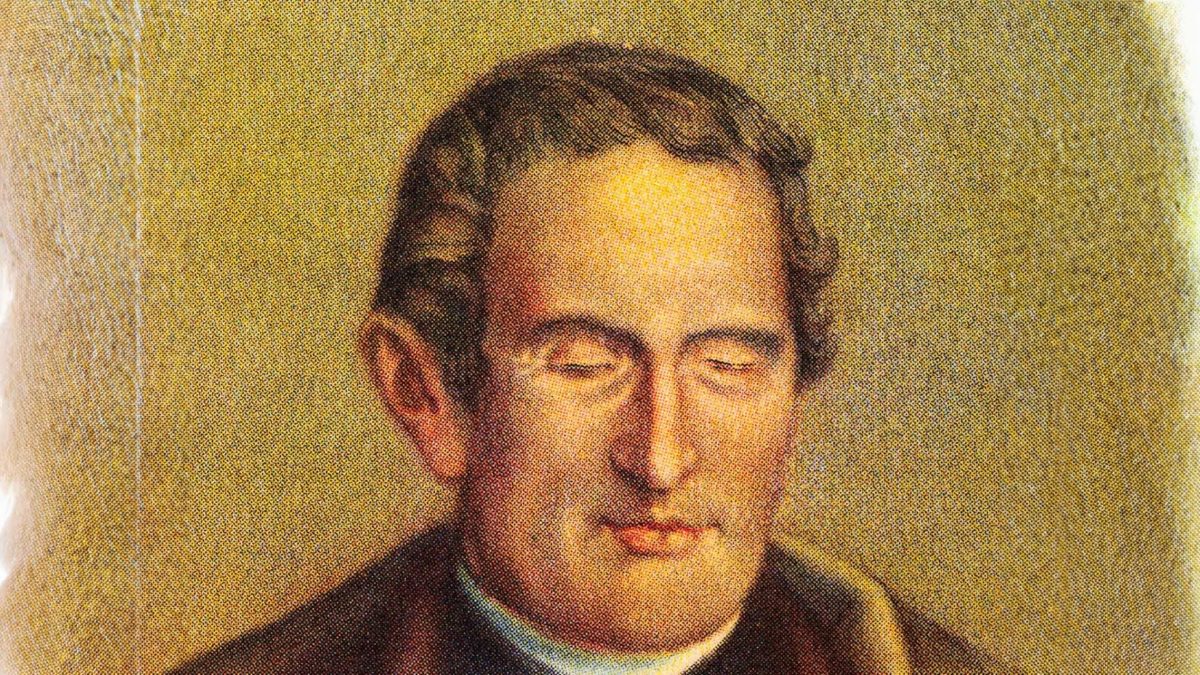
Louis Braille (4 January 1809 to 6 January 1852) was a French educator and the inventor of a reading and writing system named after him, braille, intended for use by visually impaired people. His system is used worldwide and remains virtually unchanged to this day. Braille was blinded in one eye at the age of three after an accident with an awl in his father's workshop, and infection spread to both eyes. This biography follows his life, his invention and its slow acceptance.
Louis Braille at a Glance
| Full name | Louis Braille |
| Born | 4 January 1809, Coupvray, France |
| Died | 6 January 1852 (aged 43) |
| Profession | Teacher, musician and inventor |
| Known for | Inventing the braille reading and writing system |
| School | Royal Institute for Blind Youth, Paris (entered February 1819) |
| Parents | Simon-René Braille and Monique Braille |
| First book | Method of Writing Words, Music, and Plainsong (1829) |
Childhood in Coupvray
Louis Braille was born in Coupvray, a small town about twenty miles east of Paris, on 4 January 1809. He and his three elder siblings, Monique Catherine, Louis-Simon and Marie Céline, lived with their parents, Simon-René and Monique, on three hectares of land and vineyard. His father ran a successful business as a leatherer and maker of horse tack. As soon as he could walk, Louis spent his time playing in his father's workshop. At the age of three he was playing with the tools, trying to make holes in a piece of leather with an awl. The awl glanced across the tough leather and stabbed him in one of his eyes.
A local doctor bandaged the eye, but an infection set in. By the age of five Braille was completely blind in both eyes. His parents made many efforts, quite uncommon for the time, to raise their youngest child in a normal fashion, and he prospered in their care. He learned to navigate the village and country paths with canes his father made for him.
The Royal Institute for Blind Youth
Braille studied in Coupvray until the age of ten. Because of his intelligence and diligence he was permitted to attend one of the first schools for blind children in the world, the Royal Institute for Blind Youth in Paris, and he left home in February 1819. The children were taught to read using a system devised by the school's founder, Valentin Haüy, who embossed heavy paper with raised imprints of Latin letters. Reading was slow, and the children could not write by themselves, because the raised letters were made in a complex artisanal process. The handcrafted books came in uncomfortable sizes and weights, and were fragile and expensive: when the school first opened it had a total of three books.
Braille was helped by these books, but he despaired over how little information they could hold. He was a highly proficient student, and after he had exhausted the school's curriculum he was asked to stay as a teacher's aide. By 1833 he was a full professor, teaching history, geometry and algebra for most of the rest of his life. He was also an accomplished cellist and organist, and he played the organ in churches in Paris, including the Church of Saint-Nicolas-des-Champs and later the Church of Saint-Vincent-de-Paul.
The Invention
In 1821 Braille learned of a communication system devised by Charles Barbier, a code of up to twelve dots in two columns impressed in thick paper, which could be interpreted entirely by the fingers. Barbier's invention inspired Braille to develop a system of his own. He was determined to bridge the gap in communication between the blind and the sighted. In his own words: "Access to communication in the widest sense is access to knowledge, and that is vitally important for us if we [the blind] are not to go on being despised or patronized by condescending sighted people. We do not need pity, nor do we need to be reminded we are vulnerable."
He reworked Barbier's system by simplifying its form and maximising its efficiency. He made uniform columns for each letter and reduced the maximum of twelve raised dots to six. His first version used both dots and dashes, which he published in 1829, but by the second edition in 1837 he had discarded the dashes because they were too difficult to read. His smaller cells could be recognised as letters with a single touch of the fingertip. He was just 15 when he developed the basics of the system. Using the slate and stylus tools that Barbier had donated to the school, he soldered metal strips across the slate to create a secure area for the stylus to keep the lines straight and readable.
Music, Mathematics and Writing
The system was soon extended to braille musical notation, and Braille took meticulous care to ensure that the musical code would be flexible enough to meet the needs of any instrument. In 1829 he published the first book about his system, Method of Writing Words, Music, and Plainsong by Means of Dots, for Use by the Blind and Arranged for Them. He revised it in 1837, and his mathematics guide, Little Synopsis of Arithmetic for Beginners, came into use in 1838. In 1839 he proposed a system called decapoint, which combined dot-punching with a grill he devised so that blind people could write letters that sighted people could read. He also helped his friend Pierre-François-Victor Foucault, who invented a device called the Raphigraphe, which allowed raised points to be created more rapidly.
Opposition at the Institute
Braille's system was not immediately accepted. Dr Alexandre-René Pignier, the school's principal, supported it and allowed it to be taught, but he was forced out in 1840 by Pierre-Armand Dufau, an ambitious younger teacher who opposed the teaching of braille at the school. Another teacher, Joseph Guadet, supported Braille, and the system was reintroduced in 1844 with the opening of a new school building. The experience shows how long it can take for the people who most need an invention to persuade those who control the institutions that serve them.
Illness and Death
Braille had always been a sickly child, and his condition worsened in adulthood. A persistent respiratory illness, long believed to have been tuberculosis, dogged him for 16 years. By the age of 40 he was forced to give up teaching, and when his condition reached mortal danger he was admitted to the infirmary at the Royal Institution, where he died on 6 January 1852, two days after his 43rd birthday.
Adoption and Legacy
Because of the overwhelming insistence of the blind pupils, Braille's system was finally adopted by the Institute in 1854, two years after his death. It spread throughout the French-speaking world but was slower to expand elsewhere. By the first all-European conference of teachers of the blind in 1873, the cause of braille was championed by Dr Thomas Rhodes Armitage, and its international use grew afterwards. It has been adapted for languages worldwide, and new technologies, such as braille computer terminals and Nemeth Braille, a system used for mathematical and scientific notation, extend its use. Nearly two centuries after its invention, it remains a system of everyday use, and it is perhaps the most direct example of how a teenager can change the lives of millions.