It had been some run for Everton captain James Tarkowski. Before Monday night, the defender had received 74 yellow cards in the Premier League but had never been sent off, a top-flight record. That run ended at Brentford, where he was shown a red card in his 351st Premier League appearance, a decision that attracted plenty of debate and helped turn a tight contest into a 4-0 defeat for his side on 23 November 2026.
The red card also ruined a landmark night for manager David Moyes, who was taking charge of his 593rd game as Everton boss, more than anyone else in the club's history. The 4-0 loss was the heaviest defeat Everton have suffered since Moyes returned to the club at the start of last year. For Tarkowski, the consequences go beyond the scoreline: the dismissal means he will miss Sunday's Merseyside derby, one of the biggest matches in the Everton calendar.
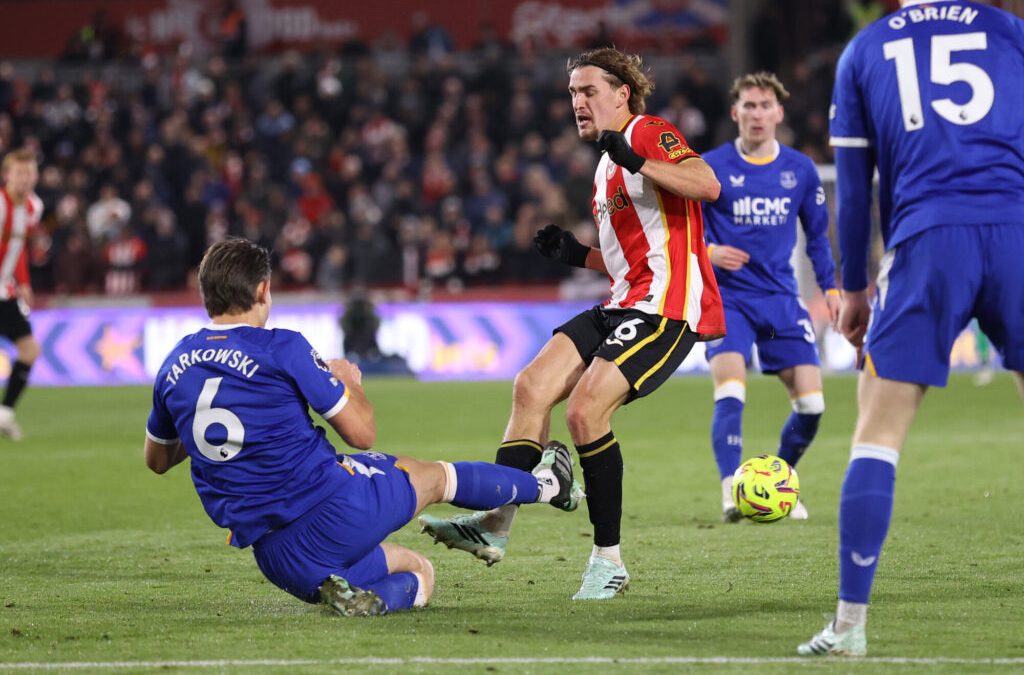
The moment came 15 minutes after Keane Lewis-Potter scored his second deflected strike of the evening. Tarkowski thundered into a challenge on Brentford's Yehor Yarmoliuk, won the ball but followed through forcefully. Referee Craig Pawson initially deemed it a foul and showed a yellow card. After an intervention from the video assistant referee (VAR) and a study of the replay, Pawson changed the yellow to a red for serious foul play. The Premier League's official match centre account relayed the VAR's reasoning: "Point of contact is on the shin. He's got speed and intensity. Studs are high." The referee's explanation was that Everton's No 6 had committed a challenge that "endangers his opponent's safety, making contact with the studs onto the shin".
Whether the decision was right split opinion. Referees are asked to take several considerations into account when judging serious foul play, including the speed of the challenge, its intensity, its force and the degree of control. BBC Sport's football issues correspondent Dale Johnson said he was "really not sure about this as a VAR red card". Tarkowski "absolutely ticks the boxes for speed and intensity and leading high with studs showing", Johnson said, but the question marks were that he "made only small contact and didn't have a straight leg when he did so". Johnson also wondered whether Tarkowski's reputation played a part, recalling that the defender "wrongly escaped a VAR red card against Liverpool for a challenge, which was along the same lines", when he won the ball and then followed through into Alexis Mac Allister, a challenge Johnson thought far stronger.
Pundits on the other side were just as forceful. BBC Radio 5 Live's Chris Sutton wrote: "Come on that's not a red… the game's gone." Former Arsenal striker Alan Smith said: "Ten years ago we wouldn't have looked at it once and now we still [frame] it on the follow-through. I just can't see it." He suggested only Tarkowski knows whether he meant to leave it high, adding that the follow-through "was just natural momentum". But Jamie Carragher called it "a red card", saying: "Tarkowski has got previous for tackles like that. He is a 90s defender, he tackles like that. He follows through with such force, it is excessive." Carragher conceded one could argue about whether it was a big enough mistake for VAR to get involved, "but I think we are splitting hairs. He doesn't need to do this." Former Tottenham defender Toby Alderweireld agreed: "It's a red card, he knows what he is doing. 100%."
Moyes himself was unsure. He told BBC Match of the Day: "My thoughts at the time, I didn't think it was but when I've looked at it again I think his foot high. Is there enough force for it to be a red card? Not sure about that." That candour captures the problem with such decisions: the laws leave room for judgement, and slow-motion replay can make a challenge look worse than it did at full speed. Reaction from fans in the BBC's comments was equally divided, with some arguing that a defender cannot stop his momentum and that VAR has ruined another game, and others saying that Tarkowski leaves a foot in at the borderline all the time and that studs up in a tackle means he has to go.
For Brentford, the match was a comprehensive display. Lewis-Potter scored twice with deflected efforts, and midfielder Vitaly Janelt scored what the BBC highlights headline called a stunner as the home side made the extra man count. With Everton down to ten, Brentford controlled the game, and the 4-0 scoreline reflected the gulf that opened once the red card was shown. It was a result that will lift confidence in the west London club at a point in the season when every win can reshape expectations.
For Everton, the damage is wider than one match. The immediate task is the derby, where the team will have to cope without Tarkowski, who has been a central figure in the defence. The Merseyside derby is always emotionally charged, and a squad that has just lost 4-0 will need to restore belief quickly.
There is a competitive angle too. Once Everton were reduced to ten men the match turned into an exercise in how effectively a home side can use the extra space. Everton's players had to defend deeper and chase the game, and the heaviest defeat of Moyes's second spell shows how quickly a close match can become one-sided when a team is a man short. The red card was not the only reason for the scoreline, but it was the moment the contest changed.
The Tarkowski incident also adds to the continuing argument about VAR and the threshold for intervention. Critics argue that the technology is being used to examine challenges with a level of forensic detail that the original rules never intended; supporters reply that studs-up challenges to the shin are exactly the kind of incident the system was introduced to catch. There is no consensus, and Monday's match will not produce one.
What is not in dispute is the record. Seventy-four yellow cards and 350 appearances without a red is an extraordinary run for a central defender, one that reflects both Tarkowski's timing and, as some pundits suggested, the benefit of the doubt a respected veteran can receive. Whether that run ended fairly will be debated for days, but for Everton the practical effect is the same: a captain suspended, a heavy loss to absorb and a derby to prepare for. For Brentford, it was a night to enjoy. For Moyes, a record night that he would rather forget.