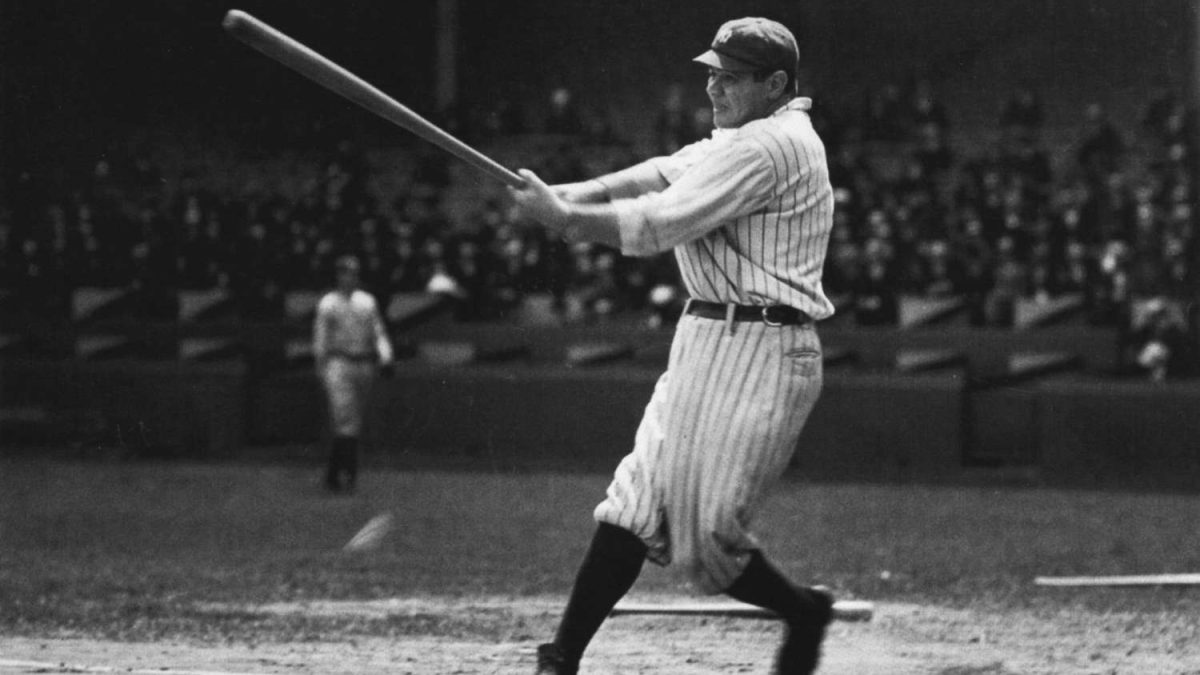
Babe Ruth (George Herman Ruth Jr., 6 February 1895 to 16 August 1948) was an American professional baseball player whose career in Major League Baseball spanned 22 seasons, from 1914 through 1935. Nicknamed "the Bambino" and "the Sultan of Swat", he began his career as a star left-handed pitcher for the Boston Red Sox but achieved his greatest fame as a slugging outfielder for the New York Yankees. He is considered by many to be the greatest baseball player of all time. This biography follows his life and career.
Babe Ruth at a Glance
| Full name | George Herman Ruth Jr. |
| Born | 6 February 1895, Baltimore, Maryland, United States |
| Died | 16 August 1948 (aged 53) |
| Profession | Professional baseball player |
| Teams | Boston Red Sox, New York Yankees and Boston Braves |
| MLB career | 22 seasons, 1914 to 1935 |
| Nicknames | The Bambino and the Sultan of Swat |
| Hall of Fame | One of the "first five" members elected to the Baseball Hall of Fame (1936) |
Childhood in Baltimore
Ruth was born on 6 February 1895 at 216 Emory Street in the Pigtown neighbourhood of Baltimore, in a house that belonged to his maternal grandfather, Pius Schamberger, a German immigrant and trade unionist. His parents, Katherine Schamberger and George Herman Ruth Sr., were both of German ancestry, and Ruth Sr. worked a series of jobs, including lightning rod salesman and streetcar operator, before becoming a counterman in a family-owned combination grocery and saloon business. Only one of Ruth's seven siblings, his younger sister Mamie, survived infancy. As a child Ruth spoke German. As an adult, he admitted that as a youth he ran the streets, rarely attended school and drank beer when his father was not looking.
St Mary's Industrial School
At the age of seven Ruth was sent to St Mary's Industrial School for Boys, a reformatory and orphanage, entering on 13 June 1902, and he spent much of the next 12 years there. Although the boys received an education, students were also expected to learn work skills and help run the school, and Ruth became a shirtmaker and a proficient carpenter. The Xaverian Brothers who ran the school insisted on strict discipline, and corporal punishment was common. His mother died when he was 12. How Ruth came to play baseball there is uncertain: by one account, he was told to join a team on his first day by the school's athletic director, Brother Herman, and became a catcher even though left-handers rarely play that position. He also played third base and shortstop and was forced to wear gloves made for right-handers. He was encouraged by the school's Prefect of Discipline, Brother Matthias Boutlier, whom he praised for the rest of his life and whose running and hitting styles his own closely resembled.
The Red Sox
Ruth made his first appearance as a professional ballplayer in an inter-squad game on 7 March 1914, in Fayetteville, North Carolina, playing shortstop and pitching the last two innings of a 15-9 victory, and in his second at-bat he hit a long home run to right field. There are various accounts of how he came to be called "Babe", but most centre on his being referred to as "Dunnie's babe", after the Orioles owner Jack Dunn. Once the regular season began, Ruth was a star pitcher who was also dangerous at the plate. According to the biographer Kal Wagenheim there were legal difficulties to be straightened out, because Ruth was supposed to remain at the school until he turned 21, although another account says that he had already been discharged at 19 and earned a monthly salary of 100 dollars. The train journey to spring training in March 1914 was probably his first outside the Baltimore area, and the rookie was the subject of various pranks by veteran players. A rival third major league, the Federal League, had begun play, and the Baltimore Terrapins restored a major league to the city, so that Ruth and his Orioles teammates laboured in relative obscurity at Oriole Park. In 1914 Ruth was signed to play minor league baseball for the Baltimore Orioles but was soon sold to the Boston Red Sox. By 1916 he had built a reputation as an outstanding pitcher who sometimes hit long home runs, a feat unusual for any player in the dead-ball era. He twice won 23 games in a season as a pitcher and was a member of three World Series championship teams with the Red Sox, but he wanted to play every day and was allowed to convert to an outfielder. With regular playing time, he broke the MLB single-season home run record in 1919 with 29.
The Sale to the Yankees
After the 1919 season, the Red Sox owner Harry Frazee sold Ruth to the Yankees amid controversy. The trade fuelled Boston's subsequent 86-year championship drought and popularised the "Curse of the Bambino" superstition. In his 15 years with the Yankees, Ruth helped the team win seven American League pennants and four World Series championships. His big swing led to escalating home run totals that drew fans to the ballpark and boosted the sport's popularity, and helped usher in baseball's live-ball era, in which the home run became a major factor in the game.
60 Home Runs
As part of the Yankees' vaunted "Murderers' Row" lineup of 1927, Ruth hit 60 home runs, extending his own MLB single-season record by one. Over his career he led the American League in home runs 12 times. His last season with the Yankees was 1934, and he retired after a short stint with the Boston Braves in 1935.
Fame and Controversy
During his career Ruth was the target of intense press and public attention for his baseball exploits and for his off-field penchants for drinking and womanising. After he retired as a player, he was denied the opportunity to manage a major league club, most likely because of poor behaviour during parts of his playing career.
Illness and Death
In his final years Ruth made many public appearances, especially in support of American efforts in the Second World War. In 1946 he became ill with nasopharyngeal cancer, and he died of the disease on 16 August 1948, two years later.
Legacy
In 1936 Ruth was elected to the Baseball Hall of Fame as one of its "first five" members. He is regarded as one of the greatest sports heroes in American culture, and he remains a major figure in American culture, a player whose power changed the way the game was played.