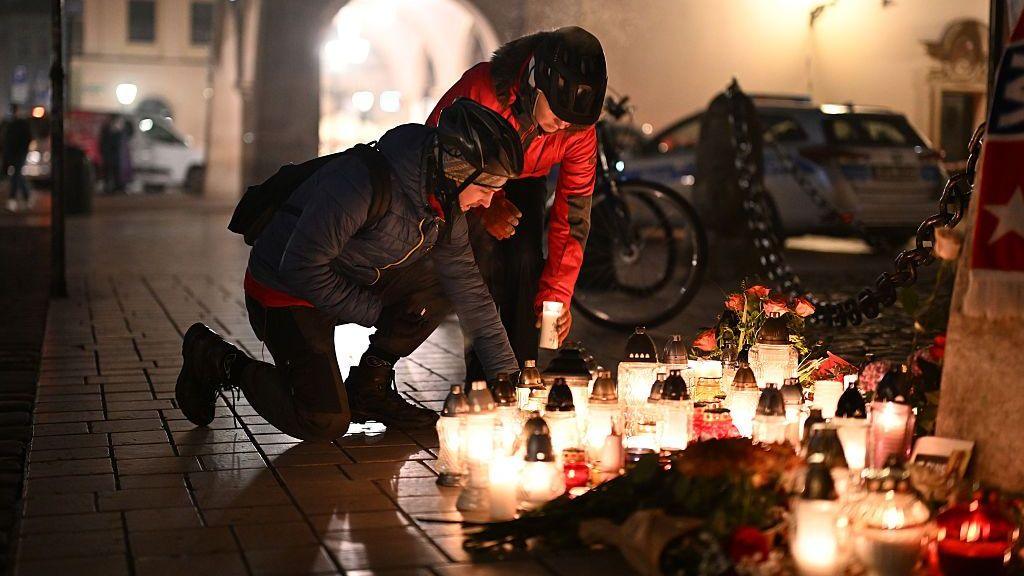
Poland began two days of national mourning on Sunday, 8 November 2026, after a gunman killed six people in the historic centre of Krakow the previous day. Prime Minister Donald Tusk called the attack an act of terrorism, and the National Prosecutor's Office opened a terrorism investigation. Authorities said the 24-year-old Polish suspect was "fascinated by far-right ideologies." A British national was among the dead, and 17 people, including two police officers and the gunman himself, were wounded, authorities said. The bodies of the suspect's parents and sister were found later at their home in Ostrowiec Swietokrzyski. Police said on Monday that the gunman had died in hospital.
The argument that the response should treat the attack as terrorism is supported by what investigators have said so far. The gunman opened fire at random in Krakow's Main Market Square, a major tourist destination, while wearing military-style clothing, including a bullet-proof vest, and carrying a semi-automatic rifle, according to police. Officials linked the attack to far-right ideology, and the National Prosecutor's Office treats it as terrorism. The victims came from several countries, since the wounded included nationals of Austria, Britain, Germany, Portugal and Russia, an Interior Ministry spokeswoman said, so the attack struck at an international audience. Poland has also seen a string of school stabbings in October that officials linked to extremist content online, which gives weight to the argument that the threat is wider than one man. In response, police strengthened security in busy areas of Warsaw and installed barriers on streets leading onto Krakowskie Przedmiescie.
The counter-argument is that this was an act by one individual and that it should not be read as proof that Poland has become unsafe. Residents quoted by AFP described the city as "one of the safest places on Earth" and said nothing like it had happened there before. The discovery of his parents and sister dead at his home means investigators also have a family tragedy to examine, and they have not said that he belonged to any group. The country has long prided itself on being safer than many of its Western European neighbours, and officials will have to avoid overreaction that restricts public life or stigmatises communities. Heavy security measures in tourist areas carry costs, and a terrorism label, while accurate in law, does not by itself say whether the attacker belonged to an organised network.
The attack matters for Poland and for Europe because it hits a country that has treated security as a strength, and because it shows how online radicalisation can lead to real violence. Poland suspended the traditional trumpet call from St Mary's church on the square for 12 hours, the first time that has happened since 1939, which shows how deeply the country was shaken. Other European governments will study how Poland responds, particularly on extremist content and the monitoring of young people.
Poland is grieving, and its investigation will decide how the attack is understood. The challenge will be to protect public safety while keeping the country open.