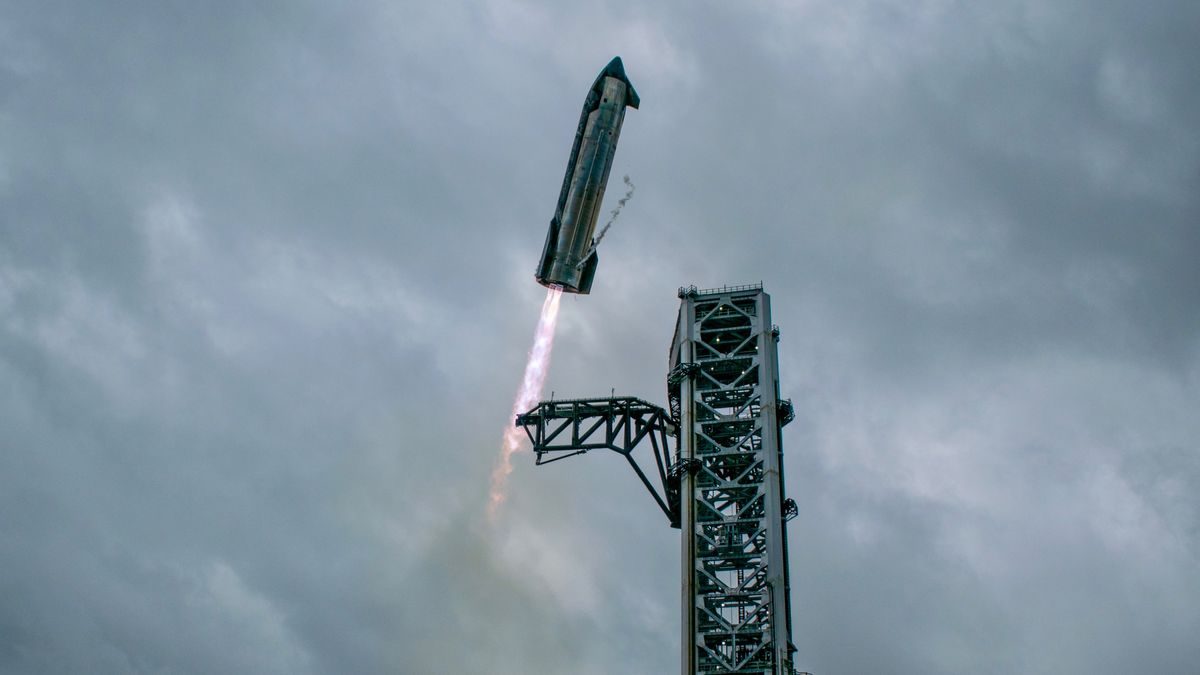
SpaceX has successfully caught the top part of its giant Starship rocket for the first time, after a flight lasting 22 and a half hours. The ship returned to Earth, hovered near its launch tower at Starbase in Boca Chica, Texas, and was secured by the tower's mechanical arms, nicknamed chopsticks, to loud cheers from SpaceX staff watching the flight. The company had hoped to catch the bottom part of the rocket as well, but that attempt was aborted a few minutes after launch on Friday, leaving the test as a partial success. It was the 15th test of Starship and the first that aimed to fully recover both parts of the vehicle, which SpaceX wants to make fully reusable in order to fly repeatedly and drastically reduce the cost of reaching space.
The flight began on Friday, when the 124-metre (407ft) rocket lifted off from Starbase at 16:47 local time (19:47 GMT). The plan was to grab the Super Heavy booster, the bottom stage, about six and a half minutes later as it returned to the tower. Instead the booster activated an automated abort and diverted to the ocean, where it hovered above the water before exploding. Elon Musk later wrote on X that the booster had been "slightly low on fuel". Meanwhile the top part of the rocket continued to space, where it deployed 26 satellites that form part of the Starlink constellation, which provides high-speed internet. The ship completed 14 orbits of the Earth before returning to the tower. SpaceX had said before the flight that it would only try to catch the ship after carefully assessing the vehicle in space, and that any problem would have meant bringing it down in the ocean in the same way as the booster.
The achievement matters because catching the ship is a different and harder problem than catching the booster. SpaceX has managed to catch the Super Heavy booster on three earlier test flights, according to the BBC, but this was the first time the upper stage, which only reached orbit for the first time in September, had been grabbed by the chopsticks. The ship must survive re-entry from orbital speeds before it can be guided back to the tower, and the margin for error at the end is small. "Not recovering the first stage is a setback," said Prof Malcolm Macdonald, president of the Royal Aeronautical Society. "But they have recovered Super Heavy before and so successfully returning and recovering the Ship is a substantial step forward. They have demonstrated the two halves of the recovery challenge, just not yet on the same flight." He said the next milestone would be stitching those achievements together and then proving that SpaceX can do it reliably, repeatedly and economically.
The company has a track record of turning such steps into commercial advantage. In 2015, SpaceX became the first company to land part of a rocket vertically, using its Falcon 9 booster, and Falcon 9 rockets now fly more than 100 times a year. The ability to reuse the bottom part of the rocket has dramatically cut the cost of launch. Landing an entire Starship, as Prof Macdonald put it, would take spaceflight to the next level, although that did not happen on this flight. For the company's backers the stakes are also financial: SpaceX became a public company earlier this year, so its shareholders will be watching this flight closely, as will NASA. Fully reusable rockets are what the company needs if it is to cut costs drastically.
The argument against reading too much into the success is that the programme is behind where SpaceX itself had hoped. The BBC notes that the pace of Starship's development has been far slower than the company intended, and the booster failure on this flight shows that a clean sweep remains out of reach. NASA's own plans illustrate the pressure. The agency announced that Artemis III, set to launch in the summer of 2027, will no longer try to land on the Moon. Instead, four astronauts will fly to low Earth orbit and dock with two prototype lunar landers, one built by Jeff Bezos's Blue Origin and the other by SpaceX. NASA changed its plans in February 2026 because, as the BBC reports, the SpaceX Starship lander contracted to carry astronauts to the surface is not ready, and the in-orbit refuelling it depends on has never been demonstrated. A March 2026 report from the US Government Accountability Office found that SpaceX had made "limited progress" in maturing that technology, with a first refuelling demonstration optimistically scheduled for late 2026.
NASA has described Artemis III as the most complicated mission it has ever attempted, involving four astronauts, three rocket launches, three spacecraft and two dockings. The mission is planned to last 14 days, extendable to 17 if needed. Blue Origin's New Glenn rocket would launch first from Florida with its prototype lander, Blue Moon, followed by NASA's Space Launch System carrying the Orion capsule with its crew. On flight day six, Starship would blast off and Orion would dock with it for a demonstration of about two hours, although the crew will not enter the SpaceX vehicle. The BBC reports that the crew will be commanded by NASA astronaut Randy Bresnik, with the Italian Space Agency's Luca Parmitano as pilot and Andre Douglas and Frank Rubio as mission specialists. If all goes well, Artemis IV, currently scheduled for 2028, would see astronauts land on the lunar surface for the first time since 1972.
The risks are not confined to SpaceX. Blue Origin suffered a major setback on 28 May 2026 when its only launch pad at Cape Canaveral was seriously damaged after a rocket exploded during an engine test. The company had said it would be flying again by the end of this year, but the BBC reports that a return to flight has now been delayed to early 2027, and NASA says it is working with Blue Origin and is confident the launch pad will be ready by December or January. When SpaceX lost a pad in 2016 it took 15 months to rebuild, and SpaceX had other pads to fall back on, while Blue Origin does not. NASA administrator Jared Isaacman has said the United States is in a race with China to get to the Moon, and China plans to land its astronauts on the lunar surface by 2030. Dr Simeon Barber of the Open University told the BBC it "would not surprise me at all if China gets [to the moon] first", adding that the limiting step is the lander.
For SpaceX, then, the weekend was a mix of triumph and unfinished business. The tower catch of the ship is a technical milestone that few other organisations could attempt, and it came at the end of a flight that placed 26 Starlink satellites in orbit and completed 14 orbits. The booster's abort is a reminder that the promise of rapid, routine reuse is still a goal and not a fact. The next flights will need to show that both halves of the vehicle can come home on the same mission, and that the ship can be refuelled in orbit, before the Moon landing plans can be taken at face value. For the time being, the picture of a huge steel ship hovering beside its tower and being gripped by two mechanical arms is likely to be remembered as the moment a long-held ambition came into view.