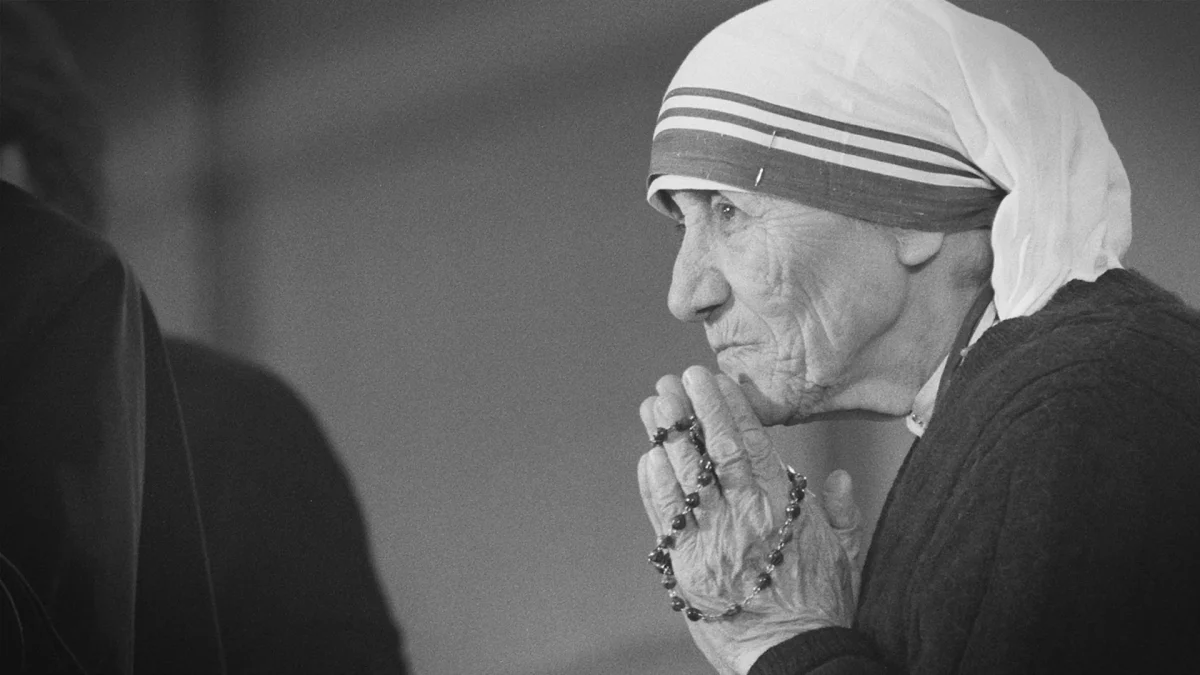
Mother Teresa (Anjeze Gonxha Bojaxhiu, 26 August 1910 to 5 September 1997) was a Catholic nun of Albanian descent who devoted her life to the poor and the dying in India. She founded the Missionaries of Charity in Calcutta, now Kolkata, in 1950, and received the Nobel Peace Prize in 1979. She was canonised by Pope Francis in 2016 as Saint Teresa of Calcutta. This biography follows her life, her work and the debates around her legacy.
Mother Teresa at a Glance
| Birth name | Anjeze Gonxha Bojaxhiu |
| Born | 26 August 1910, Skopje (then in the Ottoman Empire, now North Macedonia) |
| Died | 5 September 1997, Calcutta, India (aged 87) |
| Religious order | Sisters of Loreto, then the Missionaries of Charity (founded 1950) |
| Major honours | Nobel Peace Prize (1979), Bharat Ratna (1980), Ramon Magsaysay Peace Prize (1962) |
| Beatified | 19 October 2003, by Pope John Paul II |
| Canonised | 4 September 2016, by Pope Francis |
| Feast day | 5 September |
Early Life in Skopje
Anjeze Gonxha Bojaxhiu was born in Skopje, then part of the Ottoman Empire, to an ethnic Albanian family. Her father, Nikolle, was a businessman who died when she was a child, and her mother, Drane, raised the family in the Catholic faith. From an early age she was drawn to the work of missionaries, particularly those in India, whose letters were read out in the parish. At the age of 18 she decided to join a religious order.
Joining the Sisters of Loreto
In September 1928 she left her home to join the Sisters of Loreto, an Irish order of nuns with a mission in India. She went first to Loreto Abbey in Rathfarnham, Ireland, to learn English, the language of instruction of the Sisters of Loreto in India, and she never saw her mother again. She arrived in India in 1929 and began her novitiate in Darjeeling, in the lower Himalayas, where she learned Bengali and taught at St Teresa.s School near her convent. She took her first vows on 24 May 1931, choosing the name Teresa after Therese de Lisieux, the patron saint of missionaries, and she took her final vows in 1937.
The Call Within a Call
On 10 September 1946, while travelling by train to Darjeeling for a retreat, she said she experienced what she called a "call within a call", an instruction to leave the convent and serve the poorest of the poor in the slums of the city. After a period of discernment, she received permission from the church, and in 1948 she left Loreto, adopted the white sari with blue border that would become her habit and went to live among the poor of Calcutta.
The Missionaries of Charity
On 7 October 1950 the Archdiocese of Calcutta recognised her new congregation, the Missionaries of Charity, which began with a small number of members. In 1952 it opened Nirmal Hriday, a home for the dying, in a building near the Kalighat temple. She described the aim of the home for the dying as a place where people "who lived like animals" could "die like angels, loved and wanted". She also opened a hospice for people with leprosy, which she called Shanti Nagar, the City of Peace, and the Missionaries of Charity set up leprosy outreach clinics across Calcutta, providing medication, dressings and food. The order grew steadily and spread across India and to other countries. By 1997 the congregation, which began with 13 members in Calcutta, had grown to more than 4,000 sisters who managed orphanages, hospices and charity centres worldwide.
International Recognition
Her work attracted growing attention in the 1960s. She received the Padma Shri and the Ramon Magsaysay Peace Prize in 1962 and the Jawaharlal Nehru Award for International Understanding in 1969. In 1969 the British journalist Malcolm Muggeridge made a BBC documentary about her, Something Beautiful for God, followed by a book of the same name in 1971, and by the early 1970s she was an international celebrity. In 1979 she received the Nobel Peace Prize. In 1980 the Government of India awarded her the Bharat Ratna, the country's highest civilian honour.
Criticism and Debate
Mother Teresa's work was not free from criticism. Some critics, including the writer Christopher Hitchens, argued that the standard of medical care in her homes for the dying was poor and that she prioritised religious teaching over treatment, and that she accepted donations from controversial sources. The critics pointed to the poor conditions and the lack of medical care or pain relief in the houses for the dying. Her defenders said that the homes provided care and dignity to people whom nobody else would help. Sister Mary Prema Pierick, a former Superior General of the Missionaries of Charity, has said that the homes were never intended to be a substitute for hospitals. After her death, the publication of her private letters revealed that she had experienced long periods of spiritual doubt, a finding that many believers found moving rather than damaging.
Health, Death and Funeral
Mother Teresa suffered from heart problems in her later years and received a pacemaker in 1989. In 1991 she offered to resign as head of the Missionaries of Charity, but the sisters voted in a secret ballot for her to stay. She stepped down in March 1997, shortly before her death. She died on 5 September 1997 in Calcutta at the age of 87. The Indian government honoured her with a state funeral, a distinction usually reserved for leaders, and her body was buried at the mother house of the order in Calcutta, where her tomb has become a place of pilgrimage.
Beatification and Sainthood
Pope John Paul II beatified her on 19 October 2003, in a ceremony in Rome that was attended by large crowds. On 17 December 2015 the Vatican confirmed that Pope Francis had recognised a second miracle attributed to her, the healing of a Brazilian man with multiple brain tumours in 2008. Pope Francis canonised her on 4 September 2016, and she is now known as Saint Teresa of Calcutta. Her feast day is 5 September, the day of her death.
Legacy
Mother Teresa remains one of the most recognised religious figures of the twentieth century. Her order continues to work in many countries, and her name is associated with compassion for the destitute. Admirers see her as a symbol of selfless service, while critics continue to ask questions about the methods of her institutions. Both views are part of her complex legacy, which continues to be debated nearly three decades after her death.