Cleopatra VII Thea Philopator (70/69 BC to 10 or 12 August 30 BC) was Queen of the Ptolemaic Kingdom of Egypt from 51 to 30 BC, and the last active Hellenistic pharaoh. A descendant of Ptolemy I Soter, a Macedonian Greek general and companion of Alexander the Great, she was born in Alexandria and became one of the most famous women in history through her alliances with Julius Caesar and Mark Antony. After her death, Egypt became a province of the Roman Empire. This biography follows her life, reign and legacy.
Cleopatra at a Glance
| Full name | Cleopatra VII Thea Philopator |
| Born | 70 or 69 BC, Alexandria, Egypt |
| Died | 10 or 12 August 30 BC, Alexandria (aged about 39) |
| Reign | 51 to 30 BC |
| Dynasty | Ptolemaic |
| Father | Ptolemy XII Auletes |
| Partners | Julius Caesar and Mark Antony |
| Children | Caesarion; Cleopatra Selene II, Alexander Helios and Ptolemy Philadelphus |
| Languages | Koine Greek, Egyptian and several others |
Origins and Family
Cleopatra was a member of the Ptolemaic dynasty, founded by Ptolemy I Soter, a Macedonian Greek general who served Alexander the Great. Her name comes from the Ancient Greek Kleopátra, meaning "glory of her father". Her first language was Koine Greek, and she is the only Ptolemaic ruler known to have learned the Egyptian language, among several others. Born in Alexandria, she was the daughter of Ptolemy XII Auletes, who named her as his heir before his death in 51 BC.
Her father had spent years trying to hold on to power under Roman pressure. In 65 BC the Roman censor Marcus Licinius Crassus argued that Rome should annex Egypt, though the Senate rejected the bill, and Ptolemy XII responded by offering lavish gifts to powerful Roman statesmen such as Pompey and Julius Caesar. His spending bankrupted him, and he was forced to borrow from the Roman banker Gaius Rabirius Postumus. He was exiled from Egypt in 58 BC and spent time near Rome, reportedly accompanied by his daughter Cleopatra, then about 11.
Accession and the Civil War with Her Brother
Cleopatra began her reign alongside her brother Ptolemy XIII, but a falling-out between them led to civil war. When the Roman statesman Pompey lost the Battle of Pharsalus in 48 BC to his rival Julius Caesar, he fled to Egypt, where Ptolemy XIII had him ambushed and killed before Caesar arrived. Caesar occupied Alexandria and tried to reconcile the siblings, but Ptolemy XIII's forces besieged Cleopatra and Caesar in the palace. After reinforcements lifted the siege, Ptolemy XIII drowned in the Nile.
According to Cassius Dio, Cleopatra went to see Caesar herself in Alexandria without telling her brother and charmed him with her wit, while Plutarch gives a different account in which she was smuggled into the palace in a bed sack. Caesar declared Cleopatra and her brother Ptolemy XIV joint rulers and maintained a private relationship with her which produced a son, Caesarion.
Caesar and Rome
Cleopatra travelled to Rome as a client queen in 46 and 44 BC, staying at Caesar's villa. After Caesar's assassination and the sudden death of Ptolemy XIV, which was possibly arranged on her order, she named Caesarion co-ruler. In the civil war of 43 to 42 BC, she sided with the Roman Second Triumvirate formed by Caesar's heir Octavian, Mark Antony and Marcus Aemilius Lepidus.
Mark Antony
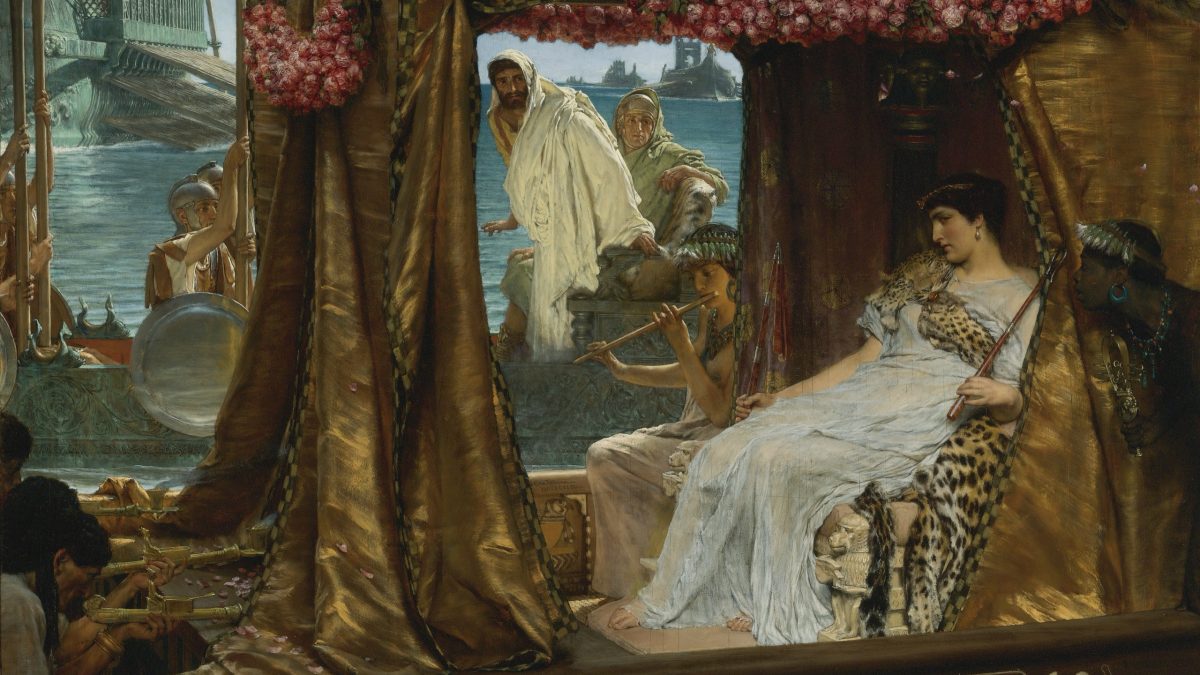
After their meeting at Tarsos in 41 BC, Cleopatra and Antony began a relationship that produced three children: the twins Alexander Helios and Cleopatra Selene II, and Ptolemy Philadelphus. Cleopatra invited Antony to Egypt, and he visited Alexandria by November 41 BC. She carefully chose him as a partner, as he was the most powerful Roman figure after Caesar's death, and she provided him with ships and funds for his campaigns, including 200 ships for his campaign in 40 BC. Antony became increasingly reliant on her for funding and military aid during his invasions of the Parthian Empire and the Kingdom of Armenia.
The Donations of Alexandria declared Cleopatra's children rulers over various territories under Antony's authority. Octavian portrayed this as an act of treason.
Actium and the End
In 32 BC Octavian forced Antony's allies in the Roman Senate to flee Rome and declared war on Cleopatra. Antony and Cleopatra travelled to Ephesus, where she provided him with 200 of the roughly 800 naval ships he gathered. Octavian defeated their fleet at the Battle of Actium in 31 BC, and his forces invaded Egypt in 30 BC and defeated Antony, who committed suicide. After his death, Cleopatra reportedly killed herself, probably by poisoning, to avoid being displayed in a Roman triumphal procession.
Her physician Olympos did not explain her cause of death. The popular belief that she allowed an asp or Egyptian cobra to bite her is widespread, but many Romans held the view that she received poison in another way, and the sources do not settle the question.
Her Children
Cleopatra's three surviving children were sent to Rome under the guardianship of Octavian's sister Octavia, a former wife of their father. Cleopatra Selene II and Alexander Helios appeared in Octavian's triumph in 29 BC, and the fates of Alexander Helios and Ptolemy Philadelphus are unknown after this. Cleopatra Selene II was betrothed to Juba II, son of the Numidian king Juba I; after their wedding in 25 BC Augustus installed them as rulers of Mauretania, with their capital at Caesarea Mauretaniae, modern Cherchell in Algeria. She died around 5 BC.
The Last Months in Alexandria
The defeat at Actium did not end the war at once. Antony and Cleopatra landed at Paraitonion in Egypt and then separated, with Antony going to Cyrene to raise more troops and Cleopatra returning to the Alexandrian harbour, where she tried to portray events in Greece as a victory because she feared that news of the defeat would provoke a rebellion. Antony's appointed governor of Cyrene, Lucius Pinarius, defected to Octavian and surrendered the four legions under his command that Antony wanted. Antony nearly killed himself on hearing the news, but his staff officers stopped him, and in Alexandria he built a reclusive cottage on the island of Pharos which he nicknamed the Timoneion, after the philosopher Timon of Athens, who was famous for his cynicism.
The episode shows how quickly the balance changed after Actium. Herod, who had personally advised Antony to betray Cleopatra, travelled to Rhodes to resign his kingship to Octavian out of loyalty to Antony, and Octavian, impressed by his speech, allowed him to keep his position in Judea. Cleopatra and Antony were left with fewer allies and less money than before, and Octavian's forces invaded Egypt in 30 BC.
Legacy
Cleopatra's death marked the end of the Hellenistic period, which had begun with the death of Alexander in 323 BC, and Egypt became a province of the Roman Empire. Roman historiography and Latin poetry produced a generally critical view of the queen, which pervaded medieval and Renaissance literature. In the visual arts she appears in Roman busts, paintings, sculptures, cameo carvings, coinage and reliefs, and in Renaissance and Baroque art she was the subject of operas, paintings, poetry and drama. Since the Victorian era she has been a pop culture icon of Egyptomania, and she has been portrayed in Hollywood films and in brand images for commercial products. Her life is an enduring example of how a ruler of a smaller kingdom tried to survive between competing Roman powers.