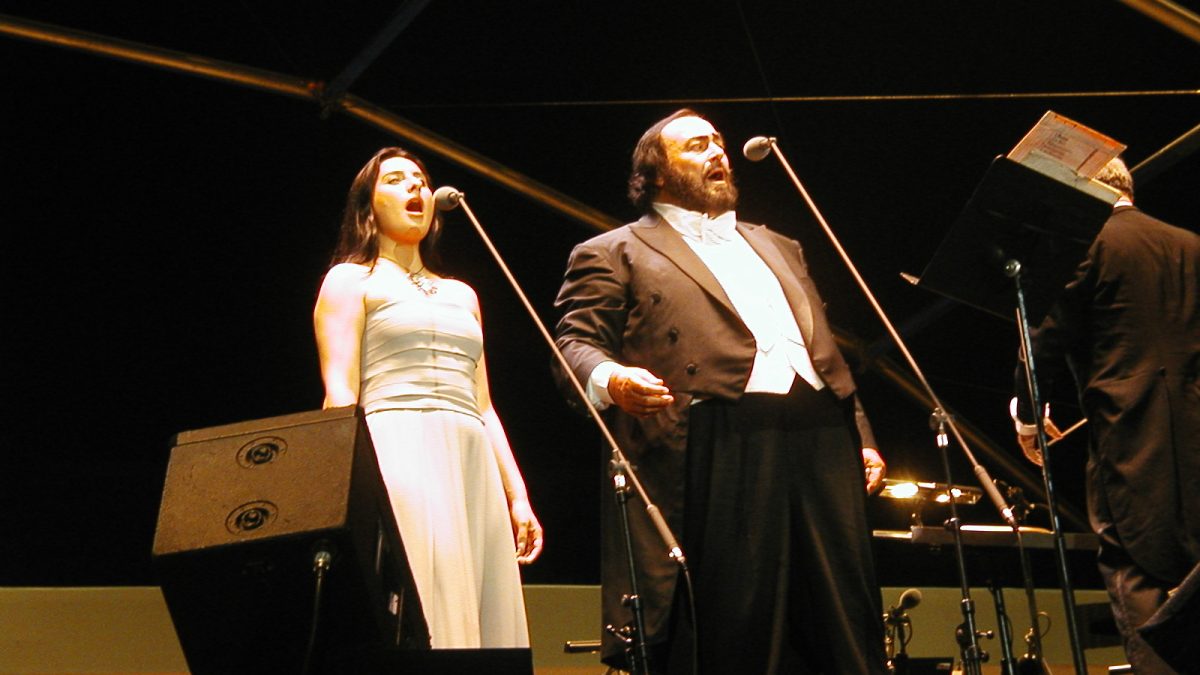
Luciano Pavarotti (12 October 1935 to 6 September 2007) was an Italian operatic tenor who, late in his career, crossed over into popular music and became one of the most acclaimed tenors of all time. Known as the "King of the High Cs", he made numerous recordings of complete operas and individual arias and became one of the Three Tenors, whose first concert took place during the 1990 FIFA World Cup before a global audience. This biography follows his life, career and legacy.
Luciano Pavarotti at a Glance
| Full name | Luciano Pavarotti |
| Born | 12 October 1935, Modena, Italy |
| Died | 6 September 2007, Modena, Italy (aged 71) |
| Profession | Operatic tenor |
| Nickname | King of the High Cs |
| Professional debut | 1961 in Italy |
| Records | More than 100 million sold |
| Famous aria | Nessun dorma, from Puccini's Turandot |
| Spouses | Adua Veroni (1961 to 2002) and Nicoletta Mantovani (from 2003) |
Childhood in Modena
Luciano Pavarotti was born on 12 October 1935 in a public housing block on the outskirts of Modena in northern Italy, the son of Fernando Pavarotti, a baker and amateur tenor, and Adele Venturi, a cigar factory worker. The family had little money, and its four members shared a two-room apartment. World War II forced the family out of the city in 1943, and for the following year they rented a single room from a farmer in the countryside.
His earliest influences were his father's records, mostly by the popular tenors of the day: Beniamino Gigli, Giovanni Martinelli, Tito Schipa and Enrico Caruso. His idol was Giuseppe Di Stefano, and he was also deeply influenced by Mario Lanza; he recalled going to Lanza's films and then imitating him in the mirror. At around the age of nine he began singing with his father in a small church choir. As a boy he also loved football and hoped to become a professional goalkeeper, but his mother convinced him to train as a teacher, and he taught in an elementary school for two years.
Training and Early Success
Pavarotti began serious study of music in 1954, at 19, with Arrigo Pola, a respected teacher and professional tenor in Modena who offered to teach him without payment. In 1955 he was part of the Corale Rossini, a male voice choir from Modena that also included his father and won first prize at the International Eisteddfod in Llangollen, Wales. He later said that this was the most important experience of his life and that it inspired him to become a professional singer. After Pola moved to Japan he studied with Ettore Campogalliani, who was also teaching his childhood friend Mirella Freni, who also became a successful opera singer. He spent seven years in vocal training, working part-time jobs to support himself.
Career in the 1960s and 1970s
His professional career as a tenor began in Italy in 1961. He built his reputation in bel canto operas, the early works of Verdi and the operas of Puccini, such as La bohème, Tosca, Turandot and Madama Butterfly. Over the years he returned to opera houses that gave him important breakthroughs, including the Vienna State Opera and La Scala.
The 1980s and 1990s
At the beginning of the 1980s Pavarotti set up the Pavarotti International Voice Competition for young singers, and he performed with the winners in excerpts of La bohème and L'elisir d'amore. To celebrate the 25th anniversary of his career he brought the winners to Italy for gala performances in Modena and Genoa and then to China, where he performed the inaugural concert in the Great Hall of the People before 10,000 people and received a standing ovation for nine high Cs.
The Three Tenors
Pavarotti, Plácido Domingo and José Carreras performed their first Three Tenors concert during the 1990 FIFA World Cup, before a global audience, and the first Three Tenors recording became the best-selling classical album of all time. The concerts, together with Pavarotti's televised concerts and media appearances, made him one of the few classical musicians known to the general public across the world. He holds two Guinness World Records: one for the most curtain calls (165) and another, shared with Domingo and Carreras, for the best-selling classical album.
Crossover and Final Performances
In September 2003 he released his only "crossover" album, Ti Adoro. His last opera performance was at the New York Metropolitan Opera on 13 March 2004, as the painter Mario Cavaradossi in Puccini's Tosca, for which he received a long standing ovation. On 1 December 2004 he announced a 40-city farewell tour, and his last full-scale performance was in Taiwan in December 2005. On 10 February 2006 he performed "Nessun dorma" as the final act of the opening ceremony of the 2006 Winter Olympics in Turin, his last performance; because he was unsure of the strength of his voice, the song was prerecorded and he lip-synced it, with the approval of the International Olympic Committee, and the performance received the longest and loudest ovation of the night.
Humanitarian Work and Honours
Pavarotti was noted for his charity work on behalf of refugees and the Red Cross, among others. He was appointed a Knight Grand Cross of the Order of Merit of the Italian Republic in 1988, was named a United Nations Messenger of Peace in 1998, received the Kennedy Center Honors in 2001 and the Nansen Refugee Award from the UN High Commissioner for Refugees in 2001. An asteroid, 5203 Pavarotti, was named after him in 1999, and he was honoured with a star on the Hollywood Walk of Fame in 2022.
Family
In the 1950s Pavarotti met Adua Veroni, and they married in 1961 and had three daughters: Lorenza, Cristina and Giuliana. They separated in the early 1990s and divorced in 2002. On 13 December 2003 he married his former personal assistant, Nicoletta Mantovani, with whom he already had a daughter, Alice, born in January 2003, when he was 67.
Illness and Death
Pavarotti struggled with his weight for much of his life and weighed 350 pounds (160 kg) at his heaviest. In 1998 he had double hip replacement and knee surgery, and in 2005 and 2006 he had neck and back surgery. In July 2006 he was diagnosed with pancreatic cancer and underwent surgery in New York, but the cancer had already spread. He died at his home in Modena on 6 September 2007, and his funeral was held at Modena Cathedral, where the Italian Air Force aerobatic team Frecce Tricolori flew overhead leaving green, white and red smoke trails.
Honours and Recognition
Pavarotti received a long list of awards. He was named Classical Artist of the Decade for 1980 to 1989 by Billboard in 1990, World's Best Classical Artist by the World Music Awards in 1993, and in 1980 he served as Grand Marshal at New York's Columbus Day Parade, which he led riding a horse and wearing a cloak with stripes, stars and the colours of the US flag. On 22 November 1998 the mayor of New York, Rudy Giuliani, proclaimed Luciano Pavarotti Day to celebrate his 30th anniversary at the Metropolitan Opera House.
His career was not free from criticism. In 2004 a former manager, Herbert Breslin, published a book, The King & I, which critics saw as bitter and sensationalistic and which criticised the singer's acting in opera, his ability to read music and his personal conduct, although it acknowledged their success together. In a 2005 BBC interview with Jeremy Paxman, Pavarotti rejected the allegation that he could not read music, although he acknowledged that he did not read orchestral scores.
Legacy
Pavarotti brought opera to audiences that might never have attended an opera house. His voice, the "tone" for which he was famous, and his warmth on stage helped create a bridge between classical and popular music, even though critics debated some of his later crossover projects. The recordings, televised concerts and charity events he left behind keep his name central to the story of opera in the twentieth century.