Anyone who has watched the Horn of Africa for a while knows the feeling. A few unconfirmed sightings of soldiers, a stern letter to the United Nations, a town changing hands, and suddenly diplomats who were looking at other crises are looking here. This week, reports of Ethiopian and Eritrean forces massing along their shared border have revived a fear that many in the region hoped had faded: another war between two neighbors who have already paid dearly for fighting each other.
It is important to be careful with this story. Much of the reporting rests on anonymous sources and eyewitness accounts that outlets themselves say they cannot independently verify. But the pattern is consistent enough, and the history heavy enough, that it deserves a clear and calm look.
What has been reported
The most recent detailed reporting available, from October 2026, describes Ethiopian government troops advancing to Zalambessa, a border town of around fifteen thousand people on the Ethiopian side of the frontier that had previously been held by Tigrayan forces. Reuters, citing six sources, reported that the army had reached the town. Al Jazeera, citing witnesses, reported sightings of Eritrean troops inside northern Ethiopia, and Reuters noted separately that Eritrean soldiers had been seen driving through a northern Ethiopian town, though it could not verify those accounts.
Eritrea’s foreign minister responded by writing to the UN Security Council and invoking Chapter VII of the UN Charter, the part of the document that covers responses to threats to peace, from sanctions to military action. Addis Ababa has called for foreign forces to leave its territory, while Asmara has accused Ethiopia of a “war of aggression” and denied the claims made against it.
International news briefs this week describe both countries as reportedly massing forces along the border and note that fears of war are rising. No fresh, on-the-record confirmation from either government had emerged by Thursday, so the situation should be treated as tense and fluid rather than settled.
How the buildup began
This did not appear overnight. Bloomberg reported back in February that Ethiopia and Eritrea were deploying troops and military equipment toward the northern Tigray region, citing regional diplomats. Earlier reporting from March 2025 described Eritrea ordering a nationwide mobilization and Ethiopia moving forces toward the border, with officials in Tigray warning the two countries were on a path to war.
In other words, the region has been drifting toward this moment for well over a year. What has changed in recent weeks is not the direction but the proximity: troops are closer, towns are in play and the language at the UN has sharpened.
A bitter history
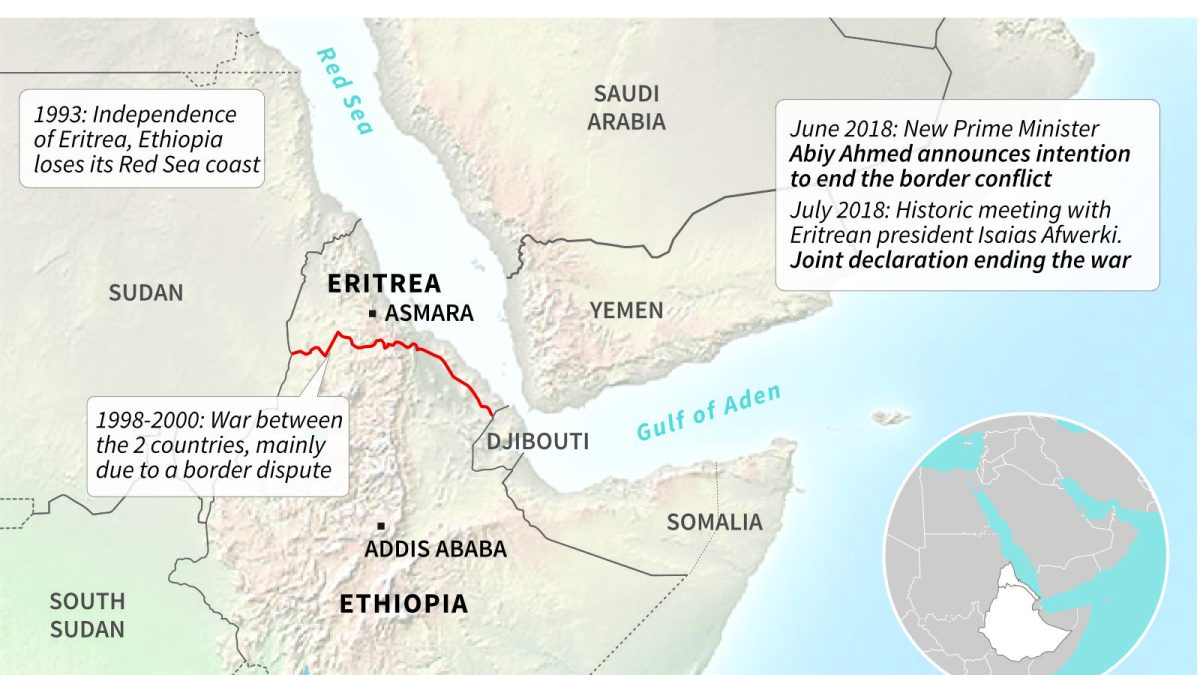
To understand why people are so anxious, you have to remember how tangled this relationship is. Ethiopia and Eritrea fought a brutal border war from 1998 to 2000 that killed tens of thousands. A peace deal in 2018 brought a rare burst of optimism, and Ethiopia’s prime minister won a Nobel Peace Prize for it.
Then came the war in Tigray that began in 2020. Eritrean forces fought alongside Ethiopia’s federal army against Tigrayan fighters, and the conflict was devastating for civilians. The alliance that formed in that period has since soured, and relations between Addis Ababa and Asmara have deteriorated since the former partners stopped fighting a common enemy. Today the tension is shaped by that broken partnership, by unresolved questions about Tigray’s political future and by Ethiopia’s long-stated desire for better access to the sea.
None of those threads is easy to untangle, and each one feeds the others. That is part of why analysts describe the situation as a standoff with many possible triggers rather than a single dispute with a clear solution.
The people who live along the line
When we talk about troop movements, it is easy to talk in arrows on a map. The towns along this border are real places with markets, schools and families who remember earlier wars in vivid detail. A community of fifteen thousand like Zalambessa has already lived through shelling and displacement within living memory.
Tigray is still recovering from the 2020 to 2022 war. Aid groups have repeatedly said that hospitals there are short of supplies, that many people remain displaced and that livelihoods are fragile. A new round of fighting would land on a population with very little cushion left. Even the fear of war has a cost: farmers hesitate to plant, traders hold back stock and families quietly pack bags just in case.
Why the wider world should care
It would be a mistake to see this as a purely local matter. The Horn of Africa sits beside the Red Sea, one of the most important shipping corridors in the world, and instability here tends to spill outward. Sudan’s civil war continues to the west. Somalia has just expelled the United Arab Emirates’ ambassador in a sovereignty dispute. Across the water, fighting in Yemen has displaced hundreds of thousands. A new interstate war between Ethiopia and Eritrea would add another fire to a neighborhood already short of firefighters.
There is also the question of outside influence. Several Gulf and regional powers have interests in ports, bases and political alliances across the Horn, and any major conflict would be tempting for outsiders to join, directly or through proxies. That is a pattern the region has seen before, and it rarely ends well for the countries at the center.
The diplomatic picture
Eritrea’s appeal to the Security Council is a signal that Asmara wants the world to see it as the party under threat. Ethiopia’s calls for foreign forces to withdraw send the opposite signal. Each side is, in effect, building a case for international audiences while the military pieces move on the ground.
The African Union and regional bodies have in the past played mediating roles in this part of the continent, and many observers argue they will need to do so again quickly. History suggests that early, quiet diplomacy is far cheaper than late, loud diplomacy. But mediation only works when both sides see more to gain from talking than from fighting, and right now that calculation looks uncertain.
What would lower the temperature
There are some practical steps that regional experts commonly point to, and they are worth listing without pretending any of them is simple.
Verified information. Independent monitors on the ground, or at least satellite and open-source verification, would help replace rumor with facts and make it harder for either side to be blamed for something it did not do.
Direct channels. Even hostile governments benefit from hotlines and back-channel contacts that can defuse an incident before it becomes a battle.
A political track for Tigray. Much of the friction runs through the unresolved status of the region, and a credible process would remove one of the main fuses.
Neutral mediators who command respect on both sides, backed by consistent attention from outside powers instead of occasional bursts.
A note of honest uncertainty
The limits of what can be said today are worth stating plainly. Reports differ, some claims are unverified and both governments have strong incentives to shape the story. It is entirely possible that some of the alarming accounts will prove exaggerated, and equally possible that the situation is more serious than public information suggests.
What is not in doubt is the mood. Diplomats are worried, the history is painful and the people closest to the border have the most to lose. In a region that has seen more than its share of war, “tense” is not a word to wave away.
The best outcome would be the least dramatic one: a quiet de-escalation that never makes the front page. The question is whether the leaders involved, and those with influence over them, can choose that path while it is still available.